



Sanctions screening can look like a simple name check. In US merchant onboarding, it is more complex. Payment providers need controls that help them identify relationships or activity that may be prohibited or restricted under US sanctions.
Office of Foreign Assets Control (OFAC) sanctions screening is one of those controls. It helps businesses identify merchants and related parties that may be subject to sanctions before a relationship is approved. However, effective screening is not limited to checking a merchant name against a sanctions list. It can also involve reviewing ownership information, investigating possible matches, and responding to changes in sanctions status over time.
Understanding sanctions screening requirements in the US is therefore important for merchant onboarding teams. This article explains which OFAC lists and programs may affect merchant screening, how ownership changes the assessment, and how sanctions screening can fit into a wider risk-based onboarding process.
For a broader view of how this fits into the wider US merchant onboarding process, see Merchant Onboarding in the US.
Key Takeaways
- OFAC does not prescribe one sanctions screening process for every payment provider. Sanctions controls should reflect the provider’s risk, the merchants it serves, and the sanctions programs that may apply.
- Sanctions screening goes beyond checking a merchant name. Payment providers may also need to consider ownership, location, business activity, and other information that could create sanctions exposure.
- The OFAC 50 Percent Rule can apply even when a merchant is not named on the SDN List. An entity can be blocked when one or more blocked persons own 50% or more of it, directly or indirectly, in aggregate.
- Sanctions screening should connect with the wider merchant onboarding process. Merchant data, ownership information, screening results, underwriting, and review decisions provide greater context when assessed together as part of the merchant risk decision.
- Sanctions risk can change after merchant approval. Ongoing sanctions screening and due diligence can help payment providers identify changes in ownership, sanctions status, business information, or other relevant risk factors throughout the merchant relationship.
What are the sanctions screening requirements in the US?
OFAC does not set one standard sanctions screening process for every payment provider. OFAC screening requirements can vary depending on sanctions programs, activities, counterparties, and risks involved. The underlying obligation is to comply with applicable OFAC sanctions and avoid prohibited dealings.
OFAC strongly encourages a risk-based approach to sanctions compliance. This means payment providers can shape their controls around factors such as the merchants they serve, the products they offer, the countries they operate in, and the level of sanctions risk they face.
During merchant onboarding, OFAC sanctions screening is one of the main controls payment providers can use to identify potential sanctions exposure before approval. It usually involves checking a merchant’s name and other relevant information against current OFAC sanctions data to identify possible sanctions concerns.
In practice, sanctions screening requirements in the US are not based on one fixed screening process. Payment providers need controls that fit their own risk and help them identify possible sanctions exposure when onboarding merchants.
The next step is understanding which OFAC sanctions lists and programs may be relevant when screening a merchant.
Which OFAC sanctions lists matter in merchant onboarding?
For sanctions list screening, payment providers should use current OFAC sanctions list data and assess each potential match in the context of the applicable sanctions program and restrictions.
Not every OFAC list will be relevant to every merchant or payment provider. The restrictions and relevance depend on the sanctions program, activity, and relationship involved.
As of September 2026, OFAC maintains several sanctions lists that may be relevant to screening, depending on the sanctions program, activity, and relationship involved:
- Specially Designated Nationals and Blocked Persons (SDN) List: Identifies sanctioned individuals, companies, groups, and other entities. This can include parties linked to targeted countries, as well as terrorists, narcotics traffickers, and others designated under US sanctions programs. Their assets are blocked, and US persons are generally prohibited from dealing with them.
- Sectoral Sanctions Identifications (SSI) List: Identifies people and companies operating in specified sectors of the Russian economy. The restrictions are set out in OFAC directives and are different from full blocking sanctions.
- Foreign Sanctions Evaders (FSE) List: Identifies certain foreign people and entities connected with sanctions evasion. OFAC states that the list is currently empty following the removal of its remaining entry on December 18, 2025, although names may be added again in the future.
- Non-SDN Palestinian Legislative Council (NS-PLC) List: Identifies certain members of the Palestinian Legislative Council who are subject to specific transaction restrictions but are not listed as SDNs.
- Correspondent Account or Payable-Through Account Sanctions (CAPTA) List: Identifies foreign financial institutions for which opening or maintaining US correspondent or payable-through accounts is prohibited or subject to restrictions or strict conditions.
- Non-SDN Menu-Based Sanctions (NS-MBS) List: Identifies people and entities subject to specific sanctions that are generally less than full blocking sanctions. The exact restriction is shown for each listed party.
- Non-SDN Chinese Military-Industrial Complex Companies (NS-CMIC) List: Identifies people and companies subject to certain restrictions connected with investments in specified Chinese military-industrial complex companies.
OFAC also publishes a Consolidated Non-SDN Sanctions List, but this is a combined data set containing the individual non-SDN lists above rather than a separate sanctions program. OFAC makes this consolidated data available to make screening and compliance easier.

What about countries and regions covered by OFAC sanctions?
OFAC does not maintain a single list of countries that US persons cannot do business with. Instead, sanctions are applied through different programs. Some, including Cuba and Iran, are broad and geographically focused, while others target specific people, companies, sectors, or activities.
For payment providers, this means merchant screening should account for both:
- OFAC sanctions lists, which identify named parties subject to restrictions; and
- OFAC sanctions programs, which may create restrictions based on a merchant’s location, activities, or other exposure.
This is why checking a merchant name against an OFAC list is only part of the assessment. A merchant may also create sanctions exposure because of where it operates, what it does, or who owns it. To make a defensible sanctions decision, payment providers need enough context to understand the full merchant relationship, which makes ownership the next important consideration.
Why OFAC screening must also consider merchant ownership
OFAC sanctions screening is not limited to checking whether a merchant’s own name appears on a sanctions list. A merchant can also be treated as blocked because of who owns it.
Under OFAC’s 50 Percent Rule, an entity is considered blocked when one or more blocked persons own 50% or more of it, directly or indirectly, in aggregate. The merchant does not need to appear by name on the SDN List for the rule to apply.
For payment providers, this means merchant sanctions screening may also need to account for ownership where it is relevant to the relationship:
- Direct ownership counts: A merchant can be blocked if a blocked person owns 50% or more of it.
- Indirect ownership counts: Ownership through other companies can also bring a merchant within the 50 Percent Rule.
- Blocked ownership is added together: If two or more blocked persons together own 50% or more of the merchant, the merchant is considered blocked.
- Control alone is different: A blocked person controlling a company does not automatically make that company blocked under the 50 Percent Rule if blocked ownership is below 50%. However, OFAC urges caution where blocked persons have significant ownership or control, and dealings directly involving a blocked person may still be prohibited.
The key point is that a clean merchant-name check does not always mean the merchant is clear from an OFAC perspective. Where relevant, payment providers also need enough ownership information to determine whether blocked ownership could bring the merchant within the OFAC 50 Percent Rule.
This is why relevant ownership information should be considered as part of OFAC sanctions screening during merchant onboarding, particularly where the 50 Percent Rule or blocked ownership may apply.
How OFAC sanctions screening fits into risk-based merchant onboarding
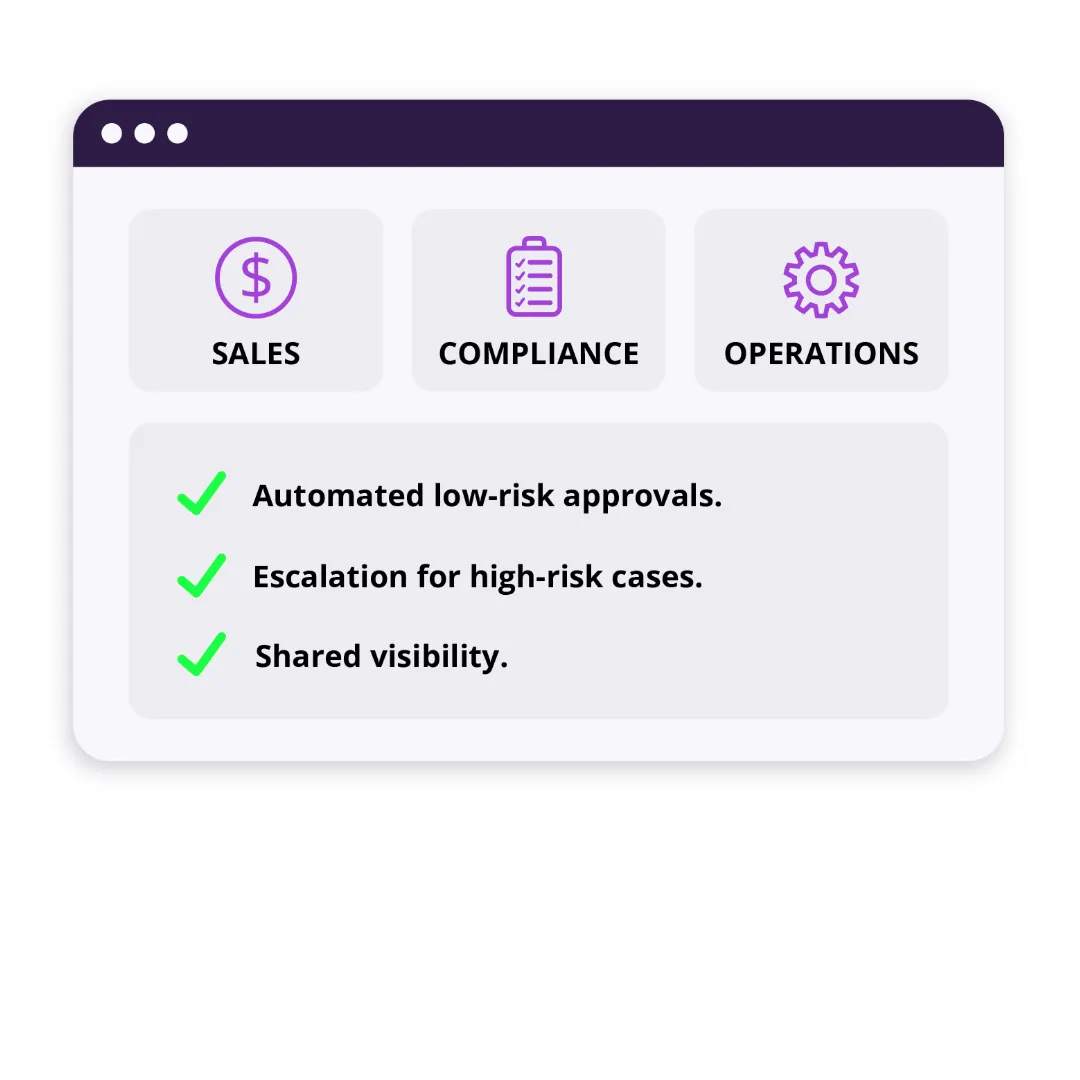
You cannot build a truly risk-based merchant onboarding process when every touchpoint operates in a silo.
If application data sits in one system, KYB and ownership checks in another, sanctions screening somewhere else, underwriting in a separate workflow, and ongoing monitoring begins only after another handoff, teams never get one complete view of merchant risk.
For PayFacs managing higher sub-merchant volumes, this same principle applies when scaling PayFac merchant onboarding without losing compliance control.
The individual checks may all happen. The problem is that they do not naturally inform each other.
That matters for OFAC sanctions screening. A possible sanctions concern may only make sense when it is viewed alongside the merchant’s ownership, location, business activity, products, supporting documents, and wider risk profile.
This aligns with OFAC’s risk-based approach to sanctions compliance. Information collected during onboarding can help payment providers understand sanctions exposure and determine what due diligence or ongoing monitoring is appropriate.
For payment providers, a connected onboarding process is one practical way to apply that principle. OFAC does not prescribe a specific onboarding platform or system architecture.
What an end-to-end merchant journey looks like
A connected merchant onboarding process starts with the first interaction and continues after the merchant is approved and begins transacting.
The key stages typically include:
- Application and data collection: gather the merchant, ownership, business, and risk information needed upfront.
- KYB, KYC, and ownership verification: confirm the business and the people behind it.
- OFAC sanctions screening: screen the merchant and relevant parties against current OFAC sanctions data and consider relevant sanctions programs.
- Merchant risk assessment: assess factors such as the merchant's business model, MCC, expected processing volume, location, fraud and chargeback exposure, credit risk, and restricted or prohibited activities.
- Merchant underwriting: assess the information collected to determine whether the merchant meets the provider's or program's risk requirements.
- Review and approval: investigate exceptions, escalate higher-risk cases, and make the onboarding decision.
- Contracting and activation: move approved merchants through to go-live.
- Ongoing due diligence: continue monitoring for changes in ownership, sanctions exposure, business activity, or other risk after the merchant starts transacting.
The key is that each stage should inform the next.
Sanctions screening is therefore not a separate moment in onboarding. It is one part of a connected merchant risk process that starts with the first application and continues throughout the relationship.
Platforms such as OnBoard by MVSI are designed for this connected model, bringing merchant data, KYB, KYC, AML screening, sanctions screening, underwriting, decisions, and ongoing customer due diligence (OCDD) into one controlled workflow.
Best practices for building a risk-based OFAC screening process with OnBoard
A connected onboarding process only works if the right information reaches the right check at the right time.
Sanctions list screening software is most useful when screening results connect with the wider merchant onboarding and risk process.
OnBoard by MVSI supports this by keeping merchant data, verification, sanctions screening, decisioning, and ongoing due diligence within one workflow.
- Collect the right data from the start. Smart Forms adapt to the merchant’s business type, location, product, and risk profile. This helps capture the information needed for verification and sanctions screening upfront.
- Understand who owns the business. OnBoard connects KYB, KYC, beneficial ownership, and AML checks within the same workflow, giving teams the ownership information needed to understand the merchant and apply the OFAC 50 Percent Rule where relevant.
- Screen for OFAC sanctions exposure. OnBoard PEP and Sanctions Screening provides automated sanctions screening for merchants, beneficial owners, and relevant parties, with potential matches reviewed alongside the merchant information already collected.
- Read and validate documents with AI. OnBoard AIQ™ reads and interprets merchant documents, extracts structured data, validates information, and can trigger the next verification or workflow step. This helps reduce manual review and improves the quality of data.
- Route risk automatically. Risk and underwriting workflows use configured rules to move applications forward or send exceptions, including sanctions concerns, to the right reviewer.
- Keep every decision traceable. OnBoard keeps screening results, supporting information, reviews, escalations, and approvals connected to the merchant record.
- Apply the same sanctions controls across partner channels. White label onboarding helps payment providers support ISOs, agents, partners, and branded merchant journeys while keeping screening rules, escalation paths, ongoing monitoring, and reporting centrally governed.
- Keep monitoring after approval. Ongoing Customer Due Diligence (OCDD) supports ongoing sanctions screening and helps identify changes in ownership, business information, and other risk factors.
The result is a clearer view of merchant risk from the first application through to ongoing monitoring.
For sanctions screening, that context matters. Teams need to know more than whether a name matched. They also need to understand who owns the business, where it operates, and whether the risk changes after approval.
By keeping this information connected, OnBoard helps payment providers review sanctions concern faster, make clearer decisions, and keep monitoring risk after the merchant goes live.
For more merchant onboarding best practices, see Merchant Onboarding in the US: Best Practices for Payment Providers.
Conclusion
Meeting sanctions screening requirements in the US is not about completing a one-off name check. The real challenge for payment providers is maintaining enough context to understand who the merchant is, who owns it, which OFAC restrictions may apply, and whether that risk changes after go-live.
A connected process keeps that context with the merchant from application through screening, underwriting, and ongoing due diligence. The goal is not more checks. It is a clearer and more defensible view of sanctions risk throughout the merchant relationship.
OnBoard by MVSI supports that model by keeping merchant data, screening results, decisions, and OCDD connected in one controlled workflow. This helps payment providers make OFAC screening part of the wider merchant risk decision, rather than treating it as a separate compliance task.
This article is provided for general informational purposes only and does not constitute legal, regulatory, compliance, or financial advice. OFAC sanctions obligations, screening expectations, and merchant onboarding requirements can vary depending on the parties, activities, jurisdictions, ownership structures, sanctions programs, and applicable requirements involved. Organizations should seek appropriate legal, compliance, or professional advice when determining the requirements and controls that apply to their business.
Related Merchant Onboarding Resources
Merchant Onboarding in the US
Learn how OnBoard helps US payment providers, PayFacs, ISOs, lenders, banks, and regulated businesses manage merchant onboarding, KYB, AML screening, underwriting, governance, and ongoing due diligence in one connected process.
US Merchant Onboarding Best Practices
Learn how US payment providers improve merchant onboarding, reduce delays, strengthen compliance controls, and support better risk decisions across the merchant lifecycle.
PayFac vs. ISO in the US: How Onboarding and Compliance Obligations Differ
Understand how PayFac and ISO onboarding structures differ, including responsibility for merchant underwriting, compliance, risk, and ongoing monitoring.
How US Payment Facilitators Can Scale Merchant Onboarding Without Losing Compliance Control
See how US PayFacs can scale sub-merchant onboarding with automation, merchant underwriting, risk management, OCDD, and compliance control.
Frequently Asked Questions
What are the sanctions screening requirements in the US?
OFAC does not set one standard screening process for every payment provider. Businesses subject to US jurisdiction must comply with applicable OFAC sanctions and avoid prohibited dealings. OFAC strongly encourages a risk-based approach, so screening controls should reflect the provider’s sanctions exposure, merchants, products, locations, and activities.
Does OFAC require payment providers to use sanctions screening software?
OFAC does not prescribe a specific sanctions screening platform or system architecture. Payment providers may use sanctions list screening software as part of a risk-based compliance process, but the controls need to be appropriate for the sanctions risks the business faces.
Which OFAC sanctions lists are relevant to merchant onboarding?
The relevant OFAC sanctions list or program depends on the merchant, activity, relationship, and sanctions exposure involved. Payment providers commonly need to consider the SDN List as well as applicable non-SDN lists and sanctions programs. Not every OFAC list will be relevant to every merchant.
What is the OFAC 50 Percent Rule?
The OFAC 50 Percent Rule provides that an entity is considered blocked when one or more blocked persons own 50% or more of it, directly or indirectly, in aggregate. The entity does not need to be separately named on the SDN List for the rule to apply.
Should merchant sanctions screening include ownership information?
Where ownership is relevant to the sanctions assessment, yes. A merchant may not appear on an OFAC sanctions list but can still be blocked because of its ownership. Payment providers therefore need enough ownership information to assess whether the OFAC 50 Percent Rule may apply.
Should sanctions screening continue after merchant onboarding?
A merchant’s sanctions risk can change after approval. Ongoing sanctions screening and due diligence can help payment providers identify changes in ownership, sanctions status, business information, or other risk factors during the merchant relationship.
How should sanctions screening fit into merchant onboarding?
Sanctions screening during merchant onboarding should connect with the information already collected about the merchant. Linking screening results with identity, ownership, business activity, underwriting, and ongoing due diligence gives payment providers more context when reviewing potential sanctions concerns.

