


.png)

Growth is what every payment facilitator (PayFac) wants, but scaling PayFac merchant onboarding comes with a trade-off. More sub-merchants can bring more payment volume, more revenue, and new opportunities to expand. But every new merchant also adds another onboarding decision that needs to be made with speed, evidence, and control.
As application volumes rise, PayFac merchant onboarding has to keep pace. Business verification, compliance screening, underwriting, and risk assessment still need to happen, but adding more manual reviews can quickly slow approvals and increase pressure on compliance and operations teams. The challenge is finding a way to move good merchants through onboarding efficiently while giving higher-risk or more complex applications the attention they need.
Verification confirms individual facts. Trusted onboarding determines whether the sub-merchant represents acceptable risk for the PayFac, its sponsoring acquirer, and the wider payments ecosystem.
For payment facilitators operating within the US merchant onboarding ecosystem, scaling successfully means getting that balance right. Sub-merchant onboarding needs to support growth without weakening the controls that protect the PayFac and its payments ecosystem.
A scalable PayFac merchant onboarding process uses automation to handle repeatable tasks while directing complex or higher-risk applications to human review. Connecting business verification, AML and sanctions screening, merchant underwriting, risk-based decisioning, exception management, and ongoing merchant risk monitoring helps US Payment Facilitators manage increasing sub-merchant volumes without relying on manual review at every stage.
Platforms such as OnBoard by MVSI are designed for this operating model, bringing digital onboarding, KYB, KYC, AML screening, merchant underwriting, approvals, exception management, and ongoing customer due diligence (OCDD) into one controlled workflow for PayFac teams.
Key Takeaways
- Scaling PayFac merchant onboarding is about scaling decisions, not just application volume. As sub-merchant portfolios grow, verification, underwriting, compliance, and risk assessment need to keep pace without creating more manual review at the same rate.
- Automation works best when it is risk-based. Repeatable checks and lower-risk applications can move through automated workflows, while complex or higher-risk cases are escalated for human review.
- Connected end-to-end merchant onboarding helps PayFacs maintain compliance control as they grow. Bringing merchant data, verification, underwriting, risk decisions, exceptions, and approvals into one workflow supports more consistent and traceable decision-making.
- PayFac risk management does not end at approval. Ongoing merchant risk monitoring is needed to identify and respond to changes in sub-merchant risk as the portfolio grows.
What is PayFac merchant onboarding?
PayFac merchant onboarding is the process of bringing a new business into a payment facilitator’s program as a sub-merchant. It involves checking the business, assessing its risk, and deciding whether it can be approved to start accepting payments.
At the center of the PayFac model is a payment facilitation structure that allows approved sub-merchants to process under the PayFac’s acquiring arrangement, rather than establishing their own direct merchant account with an acquirer.
When a business applies to become a sub-merchant, the PayFac puts the application through its merchant onboarding process, including the required verification and underwriting checks. The exact checks and approval criteria vary by program. US PayFacs typically operate within the risk requirements agreed with their sponsoring acquirer, alongside applicable card-network requirements.
As part of their sub-merchant onboarding responsibilities, PayFacs may need to:
- Verify the sub-merchant: Confirm the identity of the business, its ownership structure, and key business details through relevant Know Your Business (KYB) and Know Your Customer (KYC) checks.
- Screen for risk: Check sub-merchants against relevant sanctions and risk databases, including the US Department of the Treasury’s Office of Foreign Assets Control (OFAC) and Mastercard’s Member Alert to Control High-Risk Merchants (MATCH) system where applicable.
- Underwrite each sub-merchant: Assess the business model and potential fraud, credit, financial, compliance, regulatory, and reputational risks before making an onboarding decision.
- Apply relevant AML and compliance controls: Support the checks, escalation processes, and monitoring required under the PayFac program, sponsoring-acquirer expectations, and applicable requirements.
- Approve or escalate the application: Determine whether the sub-merchant can be approved or whether additional information or further review is needed.
Approval is not the end of the process. PayFacs also need to monitor sub-merchants and respond when their risk changes over time. As merchant portfolios grow, these responsibilities need to scale alongside onboarding.
For a broader comparison of PayFac and ISO models, see PayFac vs. ISO in the US: How Onboarding and Compliance Obligations Differ.
Why does PayFac merchant onboarding become more complex at scale?
As PayFacs onboard more sub-merchants, the challenge is not just handling more applications. They also need to manage growing fraud risks, verification complexity, and manual workloads without creating a slow onboarding experience.
As onboarding volumes grow, a number of rising challenges are making that balance harder to maintain:
- Fraud is getting harder to detect at onboarding. In 2026, Worldpay reported that 33% of organizations detect fraud during onboarding. Fraudsters are also using fake businesses and AI-generated identities and and forged or AI-generated documents to bypass KYB and KYC checks, putting more pressure on PayFacs to distinguish legitimate applicants from potential threats.
- Traditional onboarding can turn growth into a costly burden. The World Payments Report 2026 found that traditional merchant onboarding can take up to seven days and cost up to $496 per merchant. At higher volumes, those costs and delays quickly multiply. Review queues grow, teams face more pressure, and legitimate merchants are left waiting to start processing payments. For PayFacs, the very growth they are working toward can become difficult to sustain when every new merchant adds more time, cost, and manual work.
- Weak onboarding controls can put acquiring relationships under pressure. With 45% of merchant payment and fraud professionals reporting real-time payment fraud as the next biggest fraud attack overall, the pressure to keep risky merchants out of the payments ecosystem is growing. For US PayFacs, rapid growth needs to be backed by merchant underwriting and risk controls that meet the expectations of their sponsoring acquirer. Otherwise, higher merchant volumes can increase risk for both parties.
For PayFacs, the message is clear: growth cannot come at the expense of control. Scaling PayFac operations means finding a way to onboard more legitimate merchants without allowing fraud, costs, and compliance pressure to scale with them.
For PayFacs facing volume spikes or complex merchant reviews, specialist compliance support such as AML On Demand can provide additional review capacity without permanently increasing internal headcount.
How can PayFacs scale merchant onboarding without losing control?
The answer is not to add more people or push applications through faster. As portfolios grow, PayFacs need a merchant onboarding process that helps legitimate merchants move forward efficiently while giving compliance teams clear evidence that risk is still being properly assessed.
Building that trust requires several controls to work together. Strong verification, consistent merchant underwriting, risk-based reviews, connected merchant data, and clear decision records all help strengthen PayFac risk management as volumes grow.
Here is what that looks like in practice:
The goal is to make onboarding decisions faster, more consistent, and easier to control as volumes grow. PayFacs need clear risk rules, connected merchant data, and defined review paths so each application receives the right level of scrutiny.
This is where automation becomes important, but only when it works alongside human judgment.
Where should automation fit into PayFac merchant onboarding?
Automation should take care of the repeatable work that slows onboarding down as application volumes grow. This allows PayFacs to process straightforward applications faster while giving compliance and underwriting teams more time for complex cases.
Key areas to automate include:
- Dynamic data collection: Forms can automatically adapt based on the merchant’s industry, business type, risk profile, and other criteria. This helps collect the right information and documents upfront.
- KYB, KYC and AML screening: Once the right merchant data has been collected, identity and business verification, sanctions screening, and other standard checks can run automatically within the onboarding workflows.
- Risk assessment and decisioning: Merchant data and verification results should be assessed against pre-defined risk and underwriting rules to help determine whether an application can progress or needs further review.
- Exception Management: Failed checks, missing information, or risk triggers should automatically create an exception and route the application to the appropriate team instead of relying on someone to identify the issue manually.
Automation, however, should not mean removing people from the process. Complex, unusual, or higher-risk applications still need experienced compliance and underwriting teams to review the information, understand the context, and make the appropriate decision.
The aim is simple: automate what is predictable and give people more time to investigate what is not.
But automating individual tasks is only part of the answer. As merchant volumes grow, verification, underwriting, approvals, exceptions, and ongoing risk monitoring need to work together. Otherwise, bottlenecks can simply move from one stage of onboarding to another.
Building a PayFac merchant onboarding model that scales
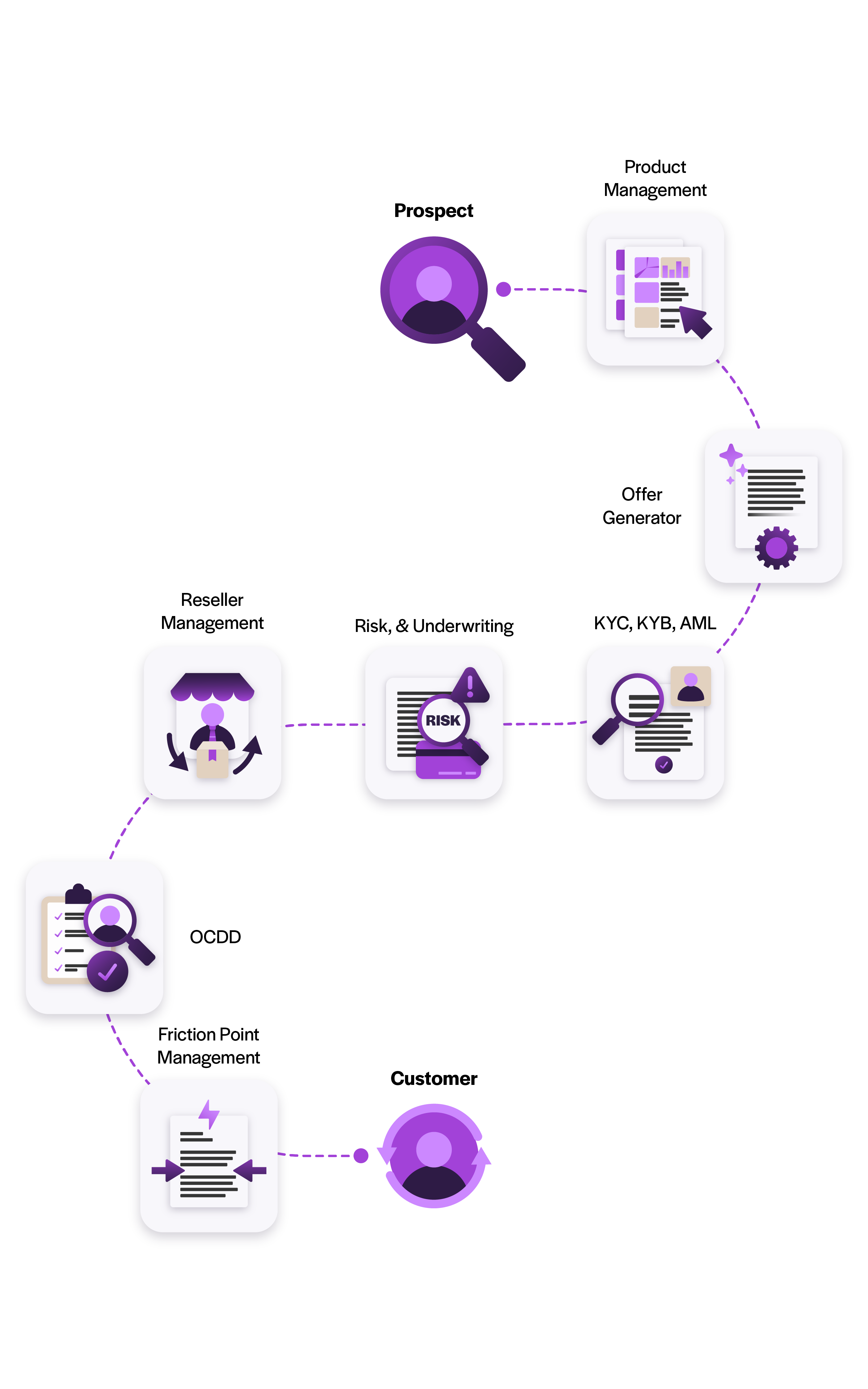
A connected PayFac merchant onboarding model brings the entire merchant journey together, from the first interaction and application through verification, underwriting, approval, going live, and ongoing monitoring. For US Payment Facilitators, this means merchant data, risk decisions, exceptions, and ongoing oversight stay connected as the relationship develops.
OnBoard by MVSI is an end-to-end merchant onboarding and compliance platform that brings these processes into one system, helping PayFacs scale merchant onboarding without creating disconnected workflows as volumes grow:
- Build risk into onboarding from the start. OnBoard Smart Forms adapt to each merchant’s business type, location, risk profile, and onboarding channel, helping PayFacs collect the right information upfront, reduce missing data, and make faster, better-informed risk decisions.
- Turn verification into trusted decisions. KYB, KYC, AML, PEP, and sanctions screening results feed directly into merchant underwriting, giving PayFacs a more complete view of risk before deciding whether a merchant can move forward.
- Reduce review queues with AI-assisted onboarding. AI reads onboarding documents in real time, extracts and validates merchant data, and automatically triggers the next action. This reduces manual review and gives underwriters the information they need to make faster decisions.
- Management by Exception. Failed checks, missing information, and risk triggers are flagged in real time and routed to the right reviewer with the full context. This lets teams focus on complex cases instead of manually reviewing every application.
- Maintain a defensible audit trail. Checks, approvals, escalations, and reviewer actions are recorded throughout onboarding, giving teams a clear audit trail.
- Adapt as the PayFac grows. Configurable workflows can support different merchant types, products, jurisdictions, risk profiles, brands, and partner channels, while helping US PayFacs adapt as acquiring, card-network, and compliance requirements change.
- Monitor risk beyond approval. Ongoing customer due diligence (OCDD) and merchant risk monitoring help PayFacs monitor changes in merchant risk as their portfolio grows.
- Scale trusted partner growth. White label merchant onboarding can support ISOs, agents, resellers, platforms, and regional partners while compliance, risk, approvals, OCDD, workflows, and reporting remain centrally controlled.
The result is a trusted, end-to-end onboarding model where capacity can grow without compliance becoming harder to control. Instead of adding disconnected processes as volumes increase, PayFacs can keep onboarding, risk decisions, exceptions, and ongoing oversight connected as their merchant portfolio grows.
For teams evaluating Payment Facilitator Onboarding at scale, OnBoard by MVSI brings these processes into one system, helping PayFacs scale merchant onboarding without creating disconnected workflows as volumes grow.
Scale merchant growth without losing compliance control
For PayFacs, growth should not mean choosing between onboarding merchants faster and keeping compliance under control. The goal is to build a PayFac merchant onboarding process that can do both.
The real measure of scale is not how many applications a PayFac can process. It is whether merchant volume can grow without manual workload, onboarding delays, and risk growing at the same rate.
That means automating predictable onboarding work, escalating complex or higher-risk applications for review, and keeping merchant data, underwriting, risk decisions, and ongoing monitoring connected as volumes grow.
OnBoard by MVSI brings these processes together in one connected platform, helping PayFacs scale merchant onboarding without losing sight of the risk behind every approval.
Disclaimer: This article is provided for general informational purposes only and does not constitute legal, regulatory, compliance, or financial advice. PayFac merchant onboarding, underwriting, AML, KYC, KYB, card-network, and sponsoring-acquirer requirements can vary depending on the PayFac program, business model, activities, and applicable requirements. Organizations should seek appropriate legal, compliance, or professional advice when determining the requirements and controls that apply to their business.
Related Merchant Onboarding Resources
Looking to improve PayFac merchant onboarding performance across your US payment program? Explore these additional resources:
Learn how OnBoard helps US payment providers, PayFacs, ISOs, lenders, banks, and regulated businesses connect merchant onboarding, KYB, AML screening, underwriting, and ongoing due diligence.
PayFac vs. ISO in the US: How Onboarding and Compliance Obligations Differ
Understand how PayFac and ISO onboarding structures differ, including responsibility for merchant underwriting, compliance, risk, and ongoing monitoring.
White Label Merchant Onboarding
Scale PayFac, ISO, agent, and reseller channels while keeping compliance, risk, approvals, and reporting centrally governed.
Business Lending Onboarding in the US: Managing Compliance, Risk, and Growth
Learn how US business lenders streamline onboarding, strengthen risk-based decision-making, and improve operational efficiency through connected onboarding and compliance workflows.
Frequently Asked Questions
What is PayFac risk management?
PayFac risk management is the process of identifying, assessing, controlling, and monitoring the risk associated with sub-merchants in a payment facilitator program. It includes merchant verification, underwriting, AML and sanctions screening, exception handling, approval controls, and ongoing merchant risk monitoring after activation.
How can US Payment Facilitators scale merchant onboarding without losing compliance control?
US Payment Facilitators can scale merchant onboarding by automating repeatable verification, screening, risk assessment, and decisioning tasks while escalating complex or higher-risk applications for human review. Keeping merchant data, underwriting decisions, exceptions, approvals, and ongoing monitoring connected helps PayFacs increase onboarding capacity without relying on more manual review at every stage.
What should PayFacs automate during sub-merchant onboarding?
PayFacs can automate dynamic data collection, KYB and KYC verification, AML and sanctions screening, risk assessment, decisioning, and exception routing. Complex, unusual, or higher-risk applications should still be reviewed by experienced compliance and underwriting teams where appropriate.
Why is merchant underwriting important when scaling PayFac operations?
Merchant underwriting helps PayFacs assess the fraud, credit, financial, compliance, regulatory, and reputational risks associated with each sub-merchant before making an onboarding decision. As application volumes grow, consistent underwriting rules and defined review paths help each application receive the appropriate level of scrutiny.
Does PayFac risk management continue after a sub-merchant is approved?
Yes. Approval is not the end of PayFac risk management. PayFacs also need to monitor sub-merchants and respond when risk changes over time. Ongoing customer due diligence (OCDD) and merchant risk monitoring can help PayFacs maintain oversight as their merchant portfolios grow.

