


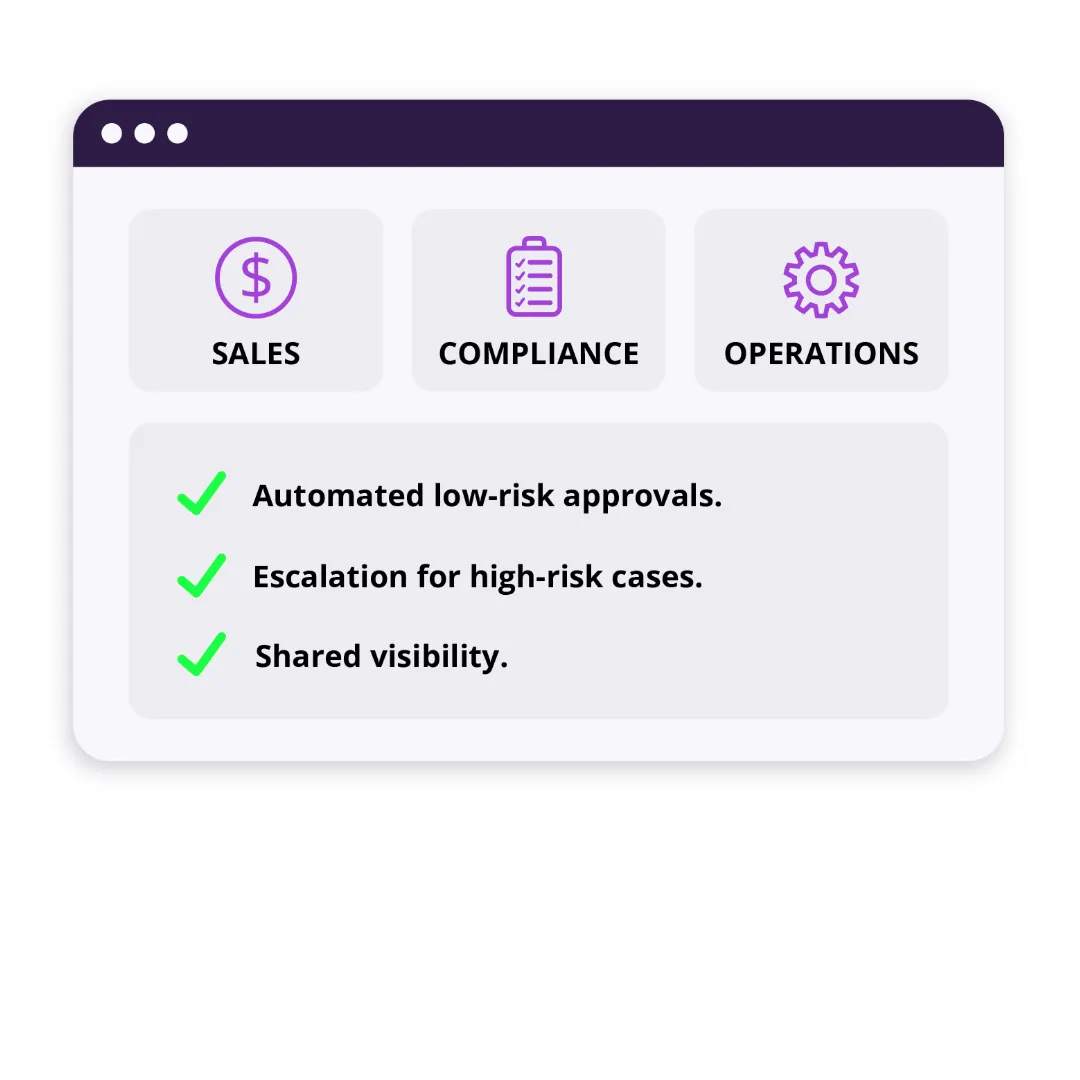

Payment providers have made significant progress in digitizing merchant onboarding. Applications can be completed online, business information can be verified automatically, and compliance checks can be run earlier in the process. But faster data collection does not automatically lead to faster merchant approval.
The real bottleneck often appears at the point of decisioning. Once the required information has been collected and verified, the provider still needs to determine what that information means from a risk perspective, whether the merchant fits its underwriting criteria, and what should happen next.
Merchant risk scoring helps create that structure. By assessing merchants against defined risk criteria, payment providers can translate onboarding data into a consistent risk outcome that supports underwriting and decisioning.
When those outcomes are connected to clear thresholds, rules, and exception workflows, straightforward merchants can move through onboarding faster while higher-risk or uncertain applications are routed for the appropriate level of review.
The goal is faster onboarding with decisions that remain consistent, explainable and defensible, helping payment providers build trusted merchant relationships at scale.
Key Takeaways
- Merchant risk scoring helps payment providers turn verified onboarding data into consistent underwriting outcomes, using defined criteria, classifications, thresholds, and decision rules.
- Risk-based automation makes onboarding faster by applying those outcomes to the merchant journey, enabling straight-through processing for low-risk merchants and routing exceptions for review.
- Scoring models are provider-specific, with the level of scrutiny, weighting, hard stops, and review triggers shaped by each provider’s risk appetite, merchant portfolio, products, jurisdictions, and underwriting policies.
- Scalable merchant risk management depends on an end-to-end data journey, where merchant information collected at application supports verification, scoring, underwriting, decisioning, and OCDD.
- Defensible onboarding decisions require visibility from day one, so payment providers can trace the data assessed, rules applied, exceptions raised, reviewer actions, and decisions made throughout the merchant relationship.
What is merchant risk scoring in merchant onboarding?
Merchant risk scoring is the process of assessing a merchant against defined risk criteria to produce a consistent risk outcome that supports onboarding and underwriting decisions.
The score can combine signals such as business type, Merchant Category Code (MCC), geography, ownership, financial exposure, expected processing activity, fraud indicators and due diligence results.
Importantly, the score is not the final decision. It helps payment providers determine what should happen next, such as whether a merchant can progress, needs additional evidence or should be routed for review.
Where risk scoring fits within the end-to-end merchant risk journey
In a typical onboarding workflow, risk scoring uses application, verification and screening data to produce a clear risk outcome that supports underwriting and the final onboarding decision.
A typical end-to-end merchant risk journey includes:
- Collect merchant data: Capture the business, ownership, financial and processing information required under the provider’s onboarding and underwriting policy.
- Verification and screening: Validate the merchant and ownership structure, complete KYC on relevant individuals, and run required AML, sanctions, PEP, and adverse media screening.
- Assess and score risk: Evaluate verified data against defined criteria to produce a risk score or classification.
- Apply decision rules: Use thresholds, risk appetite and policy rules to determine whether the merchant can proceed or needs further review.
- Onboarding outcome: Approved merchants progress toward activation, while exceptions remain within the onboarding workflow for further assessment.
- Apply ongoing customer due diligence (OCDD): Monitor the merchant relationship on an ongoing, risk-based basis and reassess risk when relevant changes or triggers occur.
Risk scoring is one part of the wider merchant onboarding process, helping payment providers move from verified merchant information into underwriting and decisioning, Understand the Full Merchant Underwriting Process.

What should payment providers assess when scoring merchant risk?
Payment providers assess merchant risk using criteria that reflect their underwriting policies and risk appetite. The exact criteria, weighting and level of scrutiny will vary by provider, merchant type, product and jurisdiction.
At a high level, the assessment typically covers:
- Business and operating characteristics
- Financial and processing exposure
- Ownership and due diligence signals
- Provider-specific risk criteria
Business and operating characteristics
Visa's Acceptance Risk Standards set risk-based onboarding and underwriting requirements for acquirers, while the OCC Merchant Processing Handbook provides additional underwriting guidance for OCC-supervised US banks.
Relevant criteria may include:
- Industry and Merchant Category Code (MCC)
- Business model
- Products or services offered
- Business location and operating markets
- Business and processing history
Financial and processing exposure
The Visa Acceptance Risk Standards and OCC Merchant Processing Handbook also support evaluating the financial and transaction exposure a merchant could create for the payment provider.
Relevant criteria may include:
- Creditworthiness and financial condition
- Expected processing volume
- Average transaction value
- Chargeback and dispute exposure
- Historical processing performance
Ownership and due diligence signals
The FATF guidance on beneficial ownership and FATF guidance on politically exposed persons provide relevant guidance for understanding ownership, control and higher-risk relationships as part of customer due diligence (CDD).
Relevant criteria may include:
- Legal entity and ownership/control structure
- Ultimate beneficial ownership (UBO) and associated-person verification
- PEP exposure & sanctions screening results
- Adverse media findings
Provider-specific risk criteria
Provider-specific risk criteria are the internal rules a payment provider uses to decide how merchant risk should affect the onboarding outcome.
Relevant criteria may include:
- Risk appetite and tolerance
- Merchant acceptance policy
- Permitted, restricted or prohibited activities
- Geographic acceptance rules
- Underwriting and approval requirements
How these factors contribute to a risk outcome will depend on the provider’s scoring model. Some may be weighted within an overall score or risk classification, while others may operate as flags, hard stops or triggers for additional review. Defined thresholds can then determine how that outcome is treated during underwriting and onboarding.
These criteria reflect examples drawn from regulatory guidance and card-network standards rather than a universal scoring framework. The level of scrutiny, weighting and complexity applied will depend on each payment provider’s risk appetite, merchant portfolio, products, jurisdictions and underwriting policies.
Once these criteria are translated into scoring thresholds and decision rules, payment providers need a consistent way to apply them across every merchant application.

How risk-based automation improves merchant onboarding
The number of checks, risk signals and underwriting rules involved in merchant onboarding can be difficult to manage manually at scale. Risk-based automation helps payment providers apply those requirements consistently while focusing human review where it is needed.
Risk-based automation uses defined risk criteria, thresholds and decision rules to determine how a merchant application moves through onboarding.
For example, it can help payment providers:
- Enable a straight-through process for low-risk merchants
- Trigger additional checks when defined risk rules or thresholds are met
- Route higher-risk or complex cases for review
- Apply scoring and decision rules consistently
This supports a management-by-exception model: routine applications can progress automatically, while cases that fall outside defined rules or thresholds are surfaced with the relevant context for human review. Controlled Automation for Risk Decisions explores how payment providers can balance automated decisioning with human oversight.
The key is that automation follows the provider’s risk policy rather than replacing it. See how OnBoard’s configurable Risk Engine can help payment providers automate risk-based merchant decisions using defined scoring criteria, thresholds and decision rules.
How payment providers can build a scalable and defensible merchant risk process
Scaling merchant risk management without losing defensibility requires risk scoring to sit within a connected, end-to-end journey. Application data, verification, risk decisions and ongoing monitoring need to remain connected so payment providers can apply policy consistently and retain the context behind each decision.
Connect merchant data to decisioning end to end
Merchant risk scoring is only as reliable as the data feeding it. Payment providers need structured application data that captures the information and evidence required for the merchant, risk profile, jurisdiction and onboarding path. Dynamic smart forms can automate that adaptation from day one.
That data should then flow into KYB, KYC, AML and screening, feed merchant risk scoring and underwriting, and establish the baseline that OCDD monitors for relevant changes after activation.
Keeping the same merchant data connected throughout the journey reduces fragmented handoffs and preserves the context behind risk decisions. For more on why verified information needs to feed into the wider approval process, see Why Verification Isn't Enough: What Acquirers and PSPs Should Really Look for in an Onboarding Platform.
Keep risk rules configurable across merchant and partner onboarding
The same risk governance also needs to scale when merchants enter the ecosystem through partners rather than directly. Payment providers may operate through partners, resellers, ISOs, agents or regional channels, with additional partner layers where permitted.
Configurable rules allow relevant risk criteria, approval gates and controls to be applied by relationship and inherited through the hierarchy where appropriate, while merchant-specific risk scoring still determines the outcome for each merchant.
This allows payment providers to scale partner-led merchant onboarding while maintaining consistent risk governance across the wider ecosystem.
Partner-level controls can remain connected to downstream merchant journeys without replacing the merchant-specific assessment required for each application.
Preserve the decision trail from day one
When merchant data stays connected end to end and risk rules are applied consistently across direct and partner-led onboarding, payment providers can maintain a clear decision trail from the first application onward.
That trail can capture:
- Merchant data and evidence collected
- Verification and screening outcomes
- Risk scores and classifications
- Rules, thresholds and inherited partner controls applied
- Exceptions, reviewer actions and overrides
- Approval, escalation or decline decisions
- OCDD changes and any resulting reassessment
This gives providers visibility into what was known, which rules applied and why each decision was made. As the relationship evolves, the same history can show how risk changed and what action followed, making merchant decisions easier to review, explain and defend.
Better merchant onboarding starts with better risk decisions
Merchant risk scoring becomes most valuable when it is part of the wider merchant risk journey rather than an isolated underwriting calculation. Connected to verified merchant data, clear decision rules and management by exception, it can help payment providers move low-risk merchants through a straight-through process while directing higher-risk or uncertain cases to the appropriate level of review.
Merchant risk management should continue after approval. Keeping merchant information, risk decisions and OCDD signals linked gives providers the context to identify relevant changes, reassess risk and maintain a trusted view of the relationship over time.
OnBoard by MVSI is an end-to-end merchant onboarding and compliance platform for regulated payments, fintech, and financial services, combining digital onboarding, KYB, KYC, AML screening, underwriting, risk decisioning, and ongoing customer due diligence (OCDD) in one connected system. This helps payment providers keep the information and decisions behind merchant risk connected throughout the relationship.
Together, this supports faster onboarding while keeping merchant risk decisions consistent, explainable and defensible, helping payment providers build trusted merchant relationships at scale.
Disclaimer: This article is provided for informational purposes only and does not constitute legal, regulatory, compliance, or business advice. Regulatory obligations vary by jurisdiction, industry, and business model. Organizations should consult qualified legal, compliance, and risk professionals when designing or updating onboarding, KYB, KYC, AML, underwriting, and risk management processes.
Related Merchant Risk Resources
Understand the Full Merchant Underwriting Process
Explore where risk scoring sits within the wider process payment providers use to evaluate merchants before approval.
Automate Risk-Based Merchant Decisions
See how configurable scoring, criteria and decision rules can automate low-risk approvals and route exceptions for review.
Controlled Automation for Risk Decisions
Learn how AI can support merchant decisioning inside defined policies, thresholds and human escalation paths.
From Verification to Trusted Decisioning
Understand why verified information is only the starting point for a confident merchant approval decision.
Frequently Asked Questions
What is merchant risk scoring?
Merchant risk scoring is the process of assessing a merchant against defined risk criteria to produce a consistent risk outcome that supports onboarding and underwriting decisions. The assessment may consider factors such as business model, Merchant Category Code (MCC), geography, ownership, financial exposure, processing activity, fraud indicators, and due diligence results.
How is merchant risk scoring different from merchant underwriting?
Merchant risk scoring structures merchant risk into a score, classification, or other defined outcome based on the provider’s criteria. Merchant underwriting is the broader process of evaluating that risk, applying policy and deciding whether the merchant should be approved, reviewed further, or declined.
What factors can affect a merchant risk score?
The factors vary by payment provider but may include business model, Merchant Category Code (MCC), geography, ownership, financial condition, expected processing activity, historical processing performance, and due diligence findings. Providers may weight some factors within a score while treating others as flags, hard stops, or manual-review triggers.
Is merchant risk scoring the same as merchant credit risk?
No. Merchant credit risk can form part of a merchant risk assessment, but payment providers may also consider processing, fraud, compliance, operational, and business-model risks. Merchant risk scoring can therefore provide a broader view of the risk associated with onboarding and maintaining the merchant relationship.
How can risk scoring support faster merchant onboarding?
Risk scoring can help payment providers apply consistent thresholds and decision rules to a merchant application. Low-risk merchants that meet defined criteria may move through a straight-through process, while higher-risk, complex, or exceptional cases can be routed to the appropriate team for review.
Does merchant risk assessment stop after onboarding?
No. The risk profile established during onboarding can provide a baseline for ongoing customer due diligence (OCDD). By monitoring merchant information for relevant changes after activation, payment providers can identify when risk needs to be reassessed and determine whether further action is required.

