


.png)

Merchant onboarding and underwriting are crucial steps for payment providers and financial institutions. In the past, these processes were heavily reliant on paperwork, manual decision-making, and lengthy verification steps. While this method worked to an extent, it often led to inefficiencies, human error, and delays—issues that become more pronounced as businesses grow.
Digital onboarding is changing how merchant underwriting is carried out. Instead of treating underwriting as a separate manual stage, payment providers can connect application data, verification, risk scoring and review within an end-to-end merchant onboarding workflow, moving routine cases faster while routing higher-risk or uncertain applications to human review.
Key Takeaways
- Traditional merchant underwriting can become a bottleneck as volumes grow. Manual data collection, sequential reviews and disconnected systems slow decisions, create rework and put more pressure on underwriting teams.
- Digital underwriting can get good merchants through faster without removing necessary controls. Verification, risk inputs and configured checks can happen earlier or in parallel, reducing unnecessary waiting between stages.
- Automation gives underwriters more time for the cases that genuinely need their expertise. Routine applications can progress within defined rules, while higher-risk, incomplete or unusual cases are routed for human review.
- Better-connected data leads to better-informed decisions. Bringing KYB, KYC, AML, ownership, financial and other risk information into the same workflow gives teams a clearer picture of the merchant before making an underwriting decision.
- The real advantage is scalability with control. Digital underwriting can help payment providers handle growing application volumes without simply adding more manual review, while keeping decision criteria, exceptions and outcomes visible and auditable.
Traditional Merchant Underwriting vs. Digital Onboarding: At a Glance
What is Merchant Underwriting?
The merchant underwriting process is a vital procedure for risk and compliance teams at payment providers and financial institutions. For compliance teams, it is the line of defense that prevents risky or unstable merchants from slipping through. Without it, the risks of fraud, chargebacks, financial instability, and regulatory breaches grow. These issues threaten trust and expose institutions to damaging consequences.
The process typically includes:
- Financial Evaluation: A thorough look into the merchant’s financial health, creditworthiness, and overall stability.
- Risk Profiling: Identifying potential risks, such as high chargeback rates, involvement in high-risk sectors (like gambling or adult entertainment), or any other issues that might pose a threat to financial or operational stability.
- Compliance and Due Diligence: Completing applicable KYB/KYC, AML, sanctions and other due diligence checks that inform the underwriting decision.
- Operational Review: A close inspection of the merchant's business model, products, services, and practices to gauge their impact on platform stability and reputation.
Merchant underwriting is foundational for safeguarding the integrity of payment systems and ensuring operational stability. Effective merchant underwriting is not just about compliance—it's about risk management, protecting reputation, and maintaining the financial and operational health of the entire payment ecosystem.
For a deeper look at the complete process, risk factors and underwriting checks, see Merchant Underwriting: The Complete Guide.
Challenges in Manual Merchant Underwriting
Manual merchant underwriting processes have long been part of risk management, but they create inefficiencies that slow teams down and weaken accuracy. For compliance officers, this means constant pressure, higher exposure to mistakes, and frustration when bottlenecks make it impossible to keep pace with growing demands.
Time-Consuming and Inefficient
Traditional underwriting often relies on paper-based systems or old technology, creating unnecessary delays. Merchants have to submit large amounts of documentation, which is then reviewed by hand. This slows down the onboarding process and impacts how quickly new accounts can be approved and revenue generated.
- Manual paperwork and reviews create bottlenecks.
- Lack of automation results in lengthy processes that can take days or weeks.
- The end result? Higher costs and slower service delivery.
Human Error and Inconsistent Decisions
The manual nature of underwriting exposes compliance and risk teams to constant risk of error, such as:
- Misinterpreting data can lead to poor decisions.
- Subjective judgments about financial stability create inconsistency.
- Inconsistent evaluations from different underwriters lead to varying outcomes.
Difficulty Spotting Red Flags Quickly
Manual, fragmented underwriting can leave risk teams piecing together important signals too late in the process, such as:
- Inconsistencies across ownership, financial, processing or business information.
- Risk indicators held across separate internal and external sources.
- Issues discovered only after a case has already moved through multiple review steps.
That delay creates more rework and can leave teams making decisions without the complete picture.
Complex Due Diligence and Data Verification
Merchant applications often require a thorough review of financial statements, tax filings, and ownership structures. Manually verifying all this information can overwhelm underwriters, leading to incomplete or inaccurate assessments.
- Cross-referencing multiple data sources complicates the process.
- Inaccurate assessments can arise from human oversight.
- Verifying ownership structures is time-consuming and prone to error.
These challenges make the underwriting process slow, resource-heavy, prone to mistakes, and hard to scale. As a result, payment providers and platforms struggle to keep up with the demands of a rapidly evolving digital landscape. Discover how our OnBoard simplifies the process.
.webp)
Technology in Merchant Underwriting
The merchant underwriting process is undergoing a major shift with automation, AI and digital onboarding. For risk and compliance teams, that can mean relief from repetitive manual work and earlier visibility into the information that genuinely needs attention. The goal is not to remove judgment. It is to give underwriters cleaner data, more consistent decision support and more time for complex cases.
1. The Evolution of Technology in Underwriting
The shift from paper-based reviews to connected digital workflows has changed how information reaches underwriting teams. Application data can be validated earlier, external sources can be queried automatically and configured criteria can be applied consistently across applications.
Key Benefits:
- Speed and Efficiency: Routine checks and data collection can happen automatically or in parallel, reducing unnecessary processing time.
- Consistency: Configured criteria can be applied the same way across applications while still allowing underwriter judgment where required.
- Capacity: Teams can spend less time on repetitive administration and more time on cases that need investigation or expertise.
2. AI-Powered Data Interpretation and Controlled Risk Decisioning
AI can now do much more in merchant underwriting than summarize information or generate a risk score. Production-ready AI can interpret unstructured documents, extract and validate merchant data, identify inconsistencies and trigger the next step in the underwriting workflow.
But useful AI in regulated underwriting still needs boundaries. It should operate within the payment provider's own rules, risk thresholds and approval policies, with clear escalation paths when a case needs human judgment.
OnBoard AIQTM is one example of this model in practice. Built into the OnBoard platform, AIQ can interpret onboarding documents in real time, turn unstructured information into usable data and trigger verification, risk or workflow actions within defined prompts, rules, criteria and thresholds.
This approach to controlled AI in merchant onboarding keeps automation within defined rules, thresholds and human oversight.
Key Benefits:
- Less Manual Review: AI can handle repetitive document interpretation, extraction and validation that would otherwise consume underwriting time.
- Better Risk Inputs: Information from documents can become structured data earlier in the process, giving risk and underwriting teams a clearer picture of the merchant.
- Controlled Decisioning: Rules, criteria and thresholds govern what happens next rather than leaving critical underwriting decisions to an unexplained AI model.
- Management by Exception: Straightforward cases can continue through the workflow while incomplete, contradictory or higher-risk applications are routed for review.
The real value of AI in underwriting comes from putting it to work. Our article on production-ready AI in merchant onboarding explores how AI can turn information into practical, controlled action throughout the onboarding process.
3. Integration with External Systems
Modern underwriting platforms now connect with third-party data sources, such as credit agencies and fraud detection services, making risk evaluation even more thorough.
Key Benefits:
- Broader Risk Context: Registry, credit, fraud, watchlist and internal information can contribute to the same underwriting assessment.
- Less Manual Rekeying: Connected systems reduce the need to transfer data between separate tools and spreadsheets.
- Faster Routing: New information can feed directly into configured risk rules and exception workflows rather than waiting for another manual review.
Together, these connections give underwriting teams broader risk context and reduce the manual work required to move information between systems.
How Digital Underwriting Supports a Governed Onboarding Decision
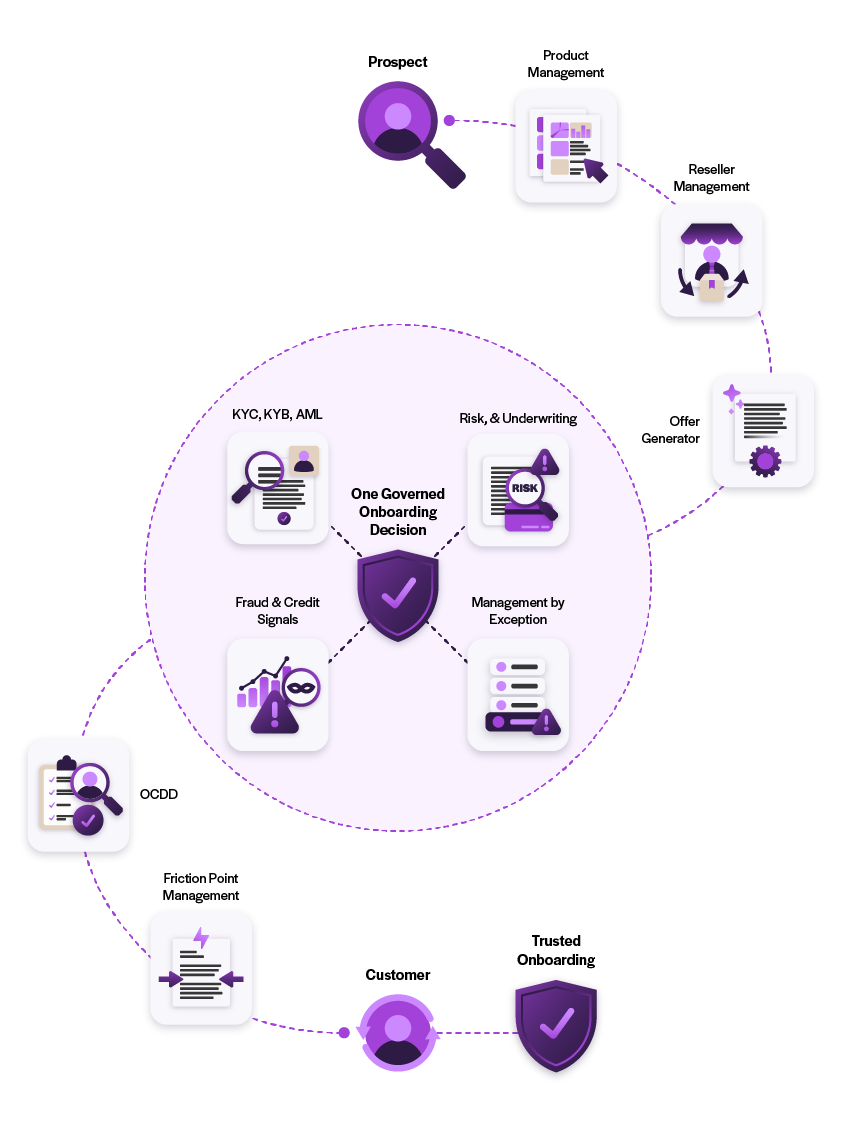
Improved Efficiency Through Digital Onboarding
Digital merchant onboarding is transforming the merchant onboarding process. For compliance teams, what was once exhausting, error-prone work is now faster and more reliable. Automated checks reduce the stress of missed details, while streamlined workflows ease the burden of repetitive tasks and restore confidence in compliance outcomes.
Key benefits include:
- Simplified Data Collection: Digital onboarding can pre-populate, validate and structure merchant data as it is entered, reducing rekeying and preventing avoidable errors from reaching underwriting.
- Faster Approvals: Automation allows for real-time evaluation of merchant applications, enabling quicker decisions and reducing time-to-market for new merchants. This is particularly important in industries where speed provides a competitive edge.
- Less Paperwork: Traditional merchant onboarding often requires piles of paperwork and document handling. With the digital onboarding process, the paperwork load is greatly reduced, making the process more efficient and secure.
How Does Digital Onboarding Cut Down on Manual Tasks?
The digital onboarding process is designed to minimize the manual work involved in the merchant underwriting process, enabling payment providers to onboard merchants quickly while maintaining security and compliance.
- Automated Document Verification: Advanced systems automatically verify documents like business registrations, financial statements, and ID proofs. This reduces human error and speeds up the approval process.
- Real-Time Risk Assessment: Digital platforms can apply configured criteria and scoring as merchant data becomes available, helping teams identify which cases can progress and which require further review.
- Seamless Integration: APIs and integrations can move data between onboarding, verification, risk and internal systems, reducing duplicate entry and manual handoffs.
For a closer look at how structured application data feeds risk scoring and automated underwriting, see From Smart Forms to Real-Time Risk Engines.
.webp)
How Does Digital Onboarding Simplify Merchant Underwriting?
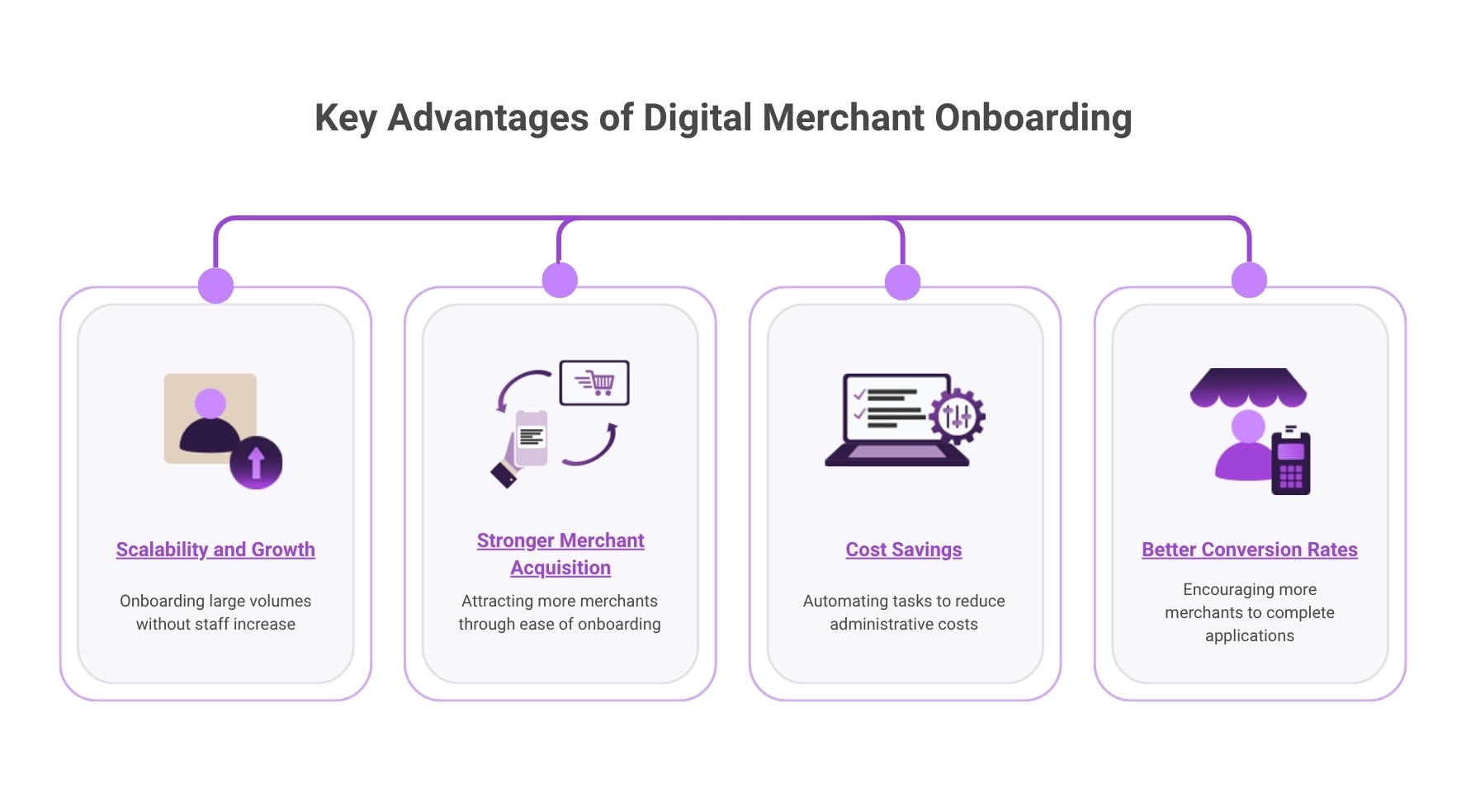
Digital onboarding does more than make individual underwriting tasks faster. By connecting data capture, verification, risk assessment and decisioning, it can change how much work teams need to do for each application and how quickly good merchants can start transacting.
- Scalability and Growth: As merchant volumes increase, automation can take on more of the repetitive data collection, verification and routing work. This allows payment providers to grow onboarding capacity without needing to increase manual review at the same rate. Configurable workflows can also support different products, merchant types, risk profiles and markets as the business expands.
- Less Friction and Fewer Lost Merchants: Digital journeys can adapt the information requested to the merchant, validate data earlier and identify missing evidence before it becomes a downstream problem. That means less back-and-forth for teams and a simpler journey for merchants, reducing avoidable friction that can contribute to abandonment.
- Faster Merchant Activation: Traditional underwriting can leave applications waiting as information moves between teams and checks are completed one after another. Digital onboarding allows many verification and risk activities to happen earlier or in parallel, helping straightforward applications reach a decision and go live sooner.
- Greater Operational Efficiency: Underwriters should not have to spend their time rekeying information, checking routine documents or chasing applications between systems. Automating repetitive work and routing exceptions to the right people gives Risk, Compliance and Underwriting teams more time to focus on complex cases where their judgment actually adds value.
The result is an underwriting process that can handle more volume, move good merchants through faster and give specialist teams greater control over where they spend their time.
Security and Risk Management
Faster underwriting only delivers value if the decision can still be trusted. For acquirers and PSPs, the challenge is not simply getting merchants through the process more quickly. It is making sure the information behind each decision is reliable, the appropriate checks have been completed, and potential risks are identified before a merchant is approved.
Digital onboarding can strengthen this process by bringing verification, document checks, risk signals, policy rules and review history into the same workflow. Instead of teams piecing together evidence across separate systems or discovering issues late in the process, more of that information can be assessed as the application progresses.
Some of the controls that can strengthen digital underwriting include:
- Identity Verification: Digital identity checks can verify the people connected to a merchant using identity documents and, where appropriate, biometric or liveness checks. Bringing these checks into the onboarding workflow can surface mismatches or missing information earlier, before they become a problem further into underwriting.
- Document Validation and Risk Signals: Automation and AI can interpret merchant-submitted documents, extract relevant information and flag missing, outdated, contradictory or suspicious details for further review. Combined with other business and risk data, this gives underwriters a more complete picture of the merchant without requiring every piece of information to be manually checked.
- Ongoing Risk Review: Risk does not stop at activation. Ongoing customer due diligence (OCDD) and post-onboarding monitoring can help payment providers identify changes in merchant information or risk over time and trigger further review when their policies require it.
The result is not underwriting without human judgment. It is underwriting where teams have better information earlier, clearer visibility into what has been checked, and more time to investigate the cases that genuinely need their expertise.
That allows payment providers to pursue faster merchant onboarding without treating speed and risk control as competing priorities.
Balancing Speed with Risk Management with Digital Onboarding
Faster merchant decisions should not mean taking shortcuts on risk. The real opportunity with digital underwriting is to remove the delays around the decision: waiting for data, repeating routine checks, moving applications between teams and manually reviewing cases that already meet clearly defined criteria.
When those activities are connected in one workflow, payment providers can move straightforward merchants through underwriting faster while still giving Risk and Compliance teams control over how decisions are made.
- Real-Time Risk Inputs: Merchant data, verification results and external risk information can be assessed as they become available rather than waiting until every stage of the application is complete. This helps surface potential issues earlier and gives underwriters a more complete picture of the merchant sooner.
- Configurable Risk Scoring: Providers can define criteria, weightings and thresholds around their own policies and risk appetite. Different rules can be applied according to factors such as merchant type, product, market or risk profile, rather than forcing every application through the same assessment.
- Management by Exception: Straightforward applications can continue automatically where policy allows, while higher-risk, incomplete or contradictory cases are routed to the appropriate team. Instead of spending the same amount of time on every merchant, underwriters can concentrate their expertise where additional judgment is actually required.
This is where digital underwriting can deliver both speed and control. The aim is not to automate judgment out of the process, but to automate the repetitive work around it and make the decision criteria, exceptions and escalation paths visible to the people responsible for risk.
For a broader look at how payment providers can reduce onboarding time across the full merchant journey while maintaining the controls needed for regulated onboarding, see Instant Onboarding at Scale: A Guide for Payment Providers.
Regulatory Considerations in Digital Onboarding
Regulatory requirements are one of the reasons merchant underwriting can become difficult to scale. Different markets, merchant types and risk profiles can require different checks, evidence and levels of review. When those requirements are managed across spreadsheets, inboxes, separate systems and individual team knowledge, maintaining consistency becomes harder as application volumes grow.
Digital onboarding gives payment providers a way to translate their own compliance policies and risk requirements into repeatable workflows. Checks can be triggered at the appropriate point in the journey, different rules can apply to different merchants, and exceptions can be surfaced for further investigation rather than every application following exactly the same path.
- KYC, KYB and AML Workflows: Identity, business verification, beneficial ownership, sanctions, PEP and other required checks can be built into the onboarding process and connected to relevant data sources. Results can feed directly into the underwriting decision, while missing information, failed checks or other exceptions are routed for review.
- Consistent Controls Across Different Journeys: A payment provider may have different requirements depending on the merchant's location, business type, product or risk profile. Configurable workflows make it easier to apply the appropriate controls consistently without forcing every merchant through the same onboarding journey.
- Ongoing Due Diligence: Approval is not the end of the risk relationship. OCDD and post-activation screening can help keep merchant information current, identify relevant changes and trigger reassessment when the provider's policies require it.
- Auditability and Evidence: Digital onboarding can create a centralized record of the information collected, checks completed, rules applied, decisions made and actions taken. That gives Risk and Compliance teams clearer evidence of how an application was assessed and supports internal review, audit and regulatory enquiries.
Digital onboarding does not make a business compliant by itself. What it can do is make the provider's own policies, controls and escalation processes easier to apply consistently, evidence and manage as merchant volumes grow.

Conclusion
The shift from traditional merchant underwriting to digital-first onboarding marks a significant change in how payment providers collect information, assess risk and move merchants toward approval.
Digital workflows can reduce repetitive manual work, apply risk criteria more consistently and surface exceptions earlier. The strongest models do not remove underwriter judgment. They give teams cleaner data, clearer rules and better visibility so human review is focused where it matters.
For payment providers, the goal is not automation for its own sake. It is a faster, more scalable underwriting process that remains explainable, configurable and under human control. Done well, digital onboarding turns underwriting from a scaling bottleneck into a controlled part of growth.
Disclaimer: This article is for general information only and does not constitute legal or regulatory advice. Requirements vary by jurisdiction, business model, and risk profile.
Frequently Asked Questions
How does merchant underwriting fit into end-to-end merchant onboarding?
Underwriting uses information collected and verified earlier in onboarding to help determine whether and how a merchant can be approved. In an end-to-end workflow, that decision record can continue into activation and ongoing due diligence.
What happens when a merchant falls outside automated approval rules?
Applications that trigger an exception can be routed with the relevant data, checks and decision history to Risk, Compliance or Underwriting for manual review.
How does risk scoring work in digital underwriting?
Risk scoring applies configured criteria and weightings to merchant information, verification results and other risk inputs. Thresholds can then help determine whether a case progresses, requires more information or is referred for review.
What is the difference between traditional and digital merchant underwriting?
Traditional underwriting typically relies more heavily on manual data collection, separate systems and underwriter-led review. Digital underwriting uses structured data, connected sources, configurable rules and automated routing to support the risk decision.
Does automated merchant underwriting replace underwriters?
No. Strong digital underwriting models automate routine checks and decisions within defined criteria while routing exceptions, higher-risk cases and uncertain outcomes to people with the appropriate expertise.

