



Merchant onboarding in Australia plays an important role in how payment providers attract, activate and retain merchants. Businesses expect a fast, straightforward experience, with clear communication and minimal delays before they can start accepting payments. But delivering that experience isn't always easy.
For acquirers, payment service providers (PSPs) and payment facilitators (PayFacs), merchant onboarding involves much more than verifying a business. From the initial application and product setup to business verification, underwriting, approvals and activation, every stage needs to work together to create a smooth onboarding journey.
The challenge is that many payment providers still rely on manual processes and disconnected systems. Merchants are asked for the same information multiple times, applications get delayed between teams, and onboarding becomes harder to manage as volumes grow. This creates unnecessary friction, increases operational costs and affects the overall merchant experience.
Modern digital merchant onboarding helps overcome these challenges by connecting every stage of the journey. From collecting merchant information and completing verification checks to underwriting, approvals, payment activation and ongoing monitoring, a connected approach reduces manual work, improves the merchant experience and makes onboarding easier to scale.
This guide explores how merchant onboarding works in Australia, the challenges payment providers face and how modern onboarding solutions can support faster activation, better merchant experiences and sustainable growth.
What is merchant onboarding in Australia?
Merchant onboarding in Australia is how payment providers approve and set up businesses to accept payments. It covers the entire journey, from the first application to merchant activation and ongoing management.
The merchant onboarding process starts with an application, business details and selection of payment products. Payment providers then complete necessary Know Your Business (KYB), Know Your Customer (KYC) and relevant Anti-Money Laundering (AML) checks. They also assess merchant risks, such as expected transaction volumes, fraud exposure and potential chargebacks, before making underwriting and approval decisions.
Once approved, merchant agreements are finalised and the relevant payment services, such as a payment gateway or terminal, are set up. The merchant can then start accepting payments. After activation, merchant monitoring and ongoing customer due diligence (OCDD), where required, help payment providers identify changes and manage risk throughout the relationship.
Merchant onboarding is more than verification and compliance. It is about helping merchants get up and running quickly, providing a smooth customer experience and making every stage of onboarding easier to manage.

How Australia's 2026 regulatory developments are reshaping merchant onboarding
Australia's regulatory landscape continues to evolve, bringing new expectations for how payment providers onboard and manage merchants. Keeping up with these changes is important, but so is making sure the onboarding process remains fast, efficient and straightforward.
Not every regulatory development applies to every payment provider. The key is knowing which requirements apply and how to meet them without slowing down merchant onboarding.
Key reforms, AUSTRAC guidance and regulatory priorities to be aware of include:
Together, these developments reinforce the importance of accurate merchant information, consistent risk assessments and ongoing oversight. For regulated payment providers, the specific requirements depend on the services they offer and any applicable transitional arrangements.
The challenge is putting these expectations into practice without creating more manual work, slower approvals or unnecessary friction for merchants.
5 merchant onboarding challenges for Australian payment providers
Australia's regulatory developments are adding to challenges payment providers already face. They need to approve merchants quickly, apply the right checks and manage risks throughout the merchant relationship.
When onboarding depends on manual processes and disconnected systems, applications get delayed, workloads grow and merchants are left waiting.
Five key challenges stand out.
1. One-size-fits-all forms create unnecessary work
Different merchant types have different information requirements. A company, partnership or association may need to provide different business details, ownership information and supporting documents. Yet many traditional static onboarding forms often put every merchant through the same lengthy application, even when many of the questions don't apply to them.
For merchants, this means spending more time filling out unnecessary details, dealing with confusing questions and waiting longer to get started. For payment providers, it means sorting through information they don't need, chasing missing documents and managing repeated follow-ups.
What should be a simple first step becomes a frustrating experience for merchants and an unnecessary workload for onboarding teams, slowing the entire journey from the start.
2. Disconnected tools make onboarding harder to manage
As expectations around verification and risk controls grow, payment providers may add standalone tools for KYB, KYC, AML screening and underwriting. Each tool handles a specific task, but the results don't always flow into the next stage.
For onboarding teams, this means constantly switching between systems, chasing results and manually piecing together information just to move an application forward.
When information is scattered across different systems, it becomes harder to see which checks are complete, what still needs attention and why an onboarding decision was made.
3. Managing merchant risk across the entire lifecycle
Merchant risk doesn't stop at approval. From the first application to underwriting, to activation and OCDD, payment providers need to keep track of changing risks throughout the merchant relationship, ideally in near real time.
Without automated, near real-time monitoring, teams are left manually checking merchant information, tracking changes in ownership, monitoring business activities and updating risk assessments. With new applications constantly coming in, keeping up with existing merchants becomes another challenge.
Missed ownership changes or shifts in business activity can leave merchant risk assessments out of date, exposing payment providers to risks they may not recognise until much later.
4. Growing onboarding friction affects the merchant experience
Merchants expect a straightforward digital experience: simple steps, clear updates and no unnecessary waiting. When they're ready to start accepting payments, they don't want to chase answers or wonder what's holding up their application.
What merchants don't see is the work happening behind the scenes. Onboarding teams are dealing with lengthy applications, switching between disconnected systems and investigating potential risks before approvals can move forward. Merchants only see repeated requests, unclear updates and frustrating delays when they're ready to start doing business.
Every day spent waiting can mean missed sales and lost opportunities. For payment providers, a poor first experience can push merchants towards competitors before the relationship even begins.
5. Scaling merchant onboarding demands more resources
Growing a merchant portfolio means more applications, checks and approvals. When every stage depends on manual work, onboarding teams can quickly struggle to keep up with demand.
For example, a payment provider expanding through multiple independent sales organisations (ISOs) can see a surge in merchant applications. Without scalable workflows, this puts more pressure on existing teams, often forcing providers to hire more staff just to keep approvals moving.
As merchant volumes grow, so do staffing costs and operational workloads. Instead of supporting growth, onboarding becomes an expensive bottleneck, making it harder for payment providers to scale profitably.

How to modernise merchant onboarding in Australia
The answer to these challenges isn't adding more tools, checks or manual reviews. It's end-to-end merchant onboarding, where every stage works together, from the first application and product setup to verification, underwriting, approvals, activation and ongoing monitoring.
By connecting the entire journey in one workflow, payment providers can reduce friction, automate routine tasks and give merchants a faster, smoother experience. At the same time, teams gain greater visibility, consistent controls and the ability to scale without constantly adding more resources.
Here are seven ways Australian payment providers can make this happen:
1. Simplify applications with dynamic smart forms
A sole trader, company and partnership shouldn't have to complete the same lengthy application. Modern providers use dynamic smart forms that adapt to each merchant's business structure, payment products, risk profile and partner channel.
For example, a business needing a card machine will be asked different questions from a business wanting to accept payments online. Smart forms automatically show the right questions for each merchant. They can also check business details against ABN Lookup and ASIC records, reducing errors and unnecessary follow-ups.
For merchants, this means shorter applications, fewer confusing questions and less back-and-forth. For payment providers, structured data captured from the start reduces rework and makes the remaining onboarding stages easier to manage.
2. Bring KYB, KYC, AML and underwriting into one workflow
Payment providers can bring KYB, KYC, AML screening, merchant underwriting and approvals into one connected workflow instead of managing them across separate tools. This also includes politically exposed person (PEP) and sanctions screening, so potential risks can be reviewed alongside other merchant information.
Merchant information flows from verification and screening into underwriting and approvals, with outstanding checks visible in one place. Once approved, the same information can support merchant agreements and payment-service setup through connected systems, without teams having to enter everything again.
Teams can see what's been verified, which decisions have been made and what still needs to happen before a merchant goes live. This reduces handovers and makes the entire journey easier to manage, from application to activation.
3. Connect real-time data with AI-assisted decision-making
Merchants shouldn't be left waiting while teams chase information across different systems. API integrations connect onboarding platforms directly to business registries, identity verification services, credit bureaus and sanctions databases. Checks happen in real time, with results flowing straight into risk assessments and underwriting.
AI-assisted decision-making takes this further. For example, OnBoard AIQtm helps extract and validate document information and trigger next steps using predefined rules, while keeping human oversight where needed.
Together, these capabilities reduce manual work, speed up decisions and help merchants start accepting payments sooner.
4. Automate onboarding through management by exception
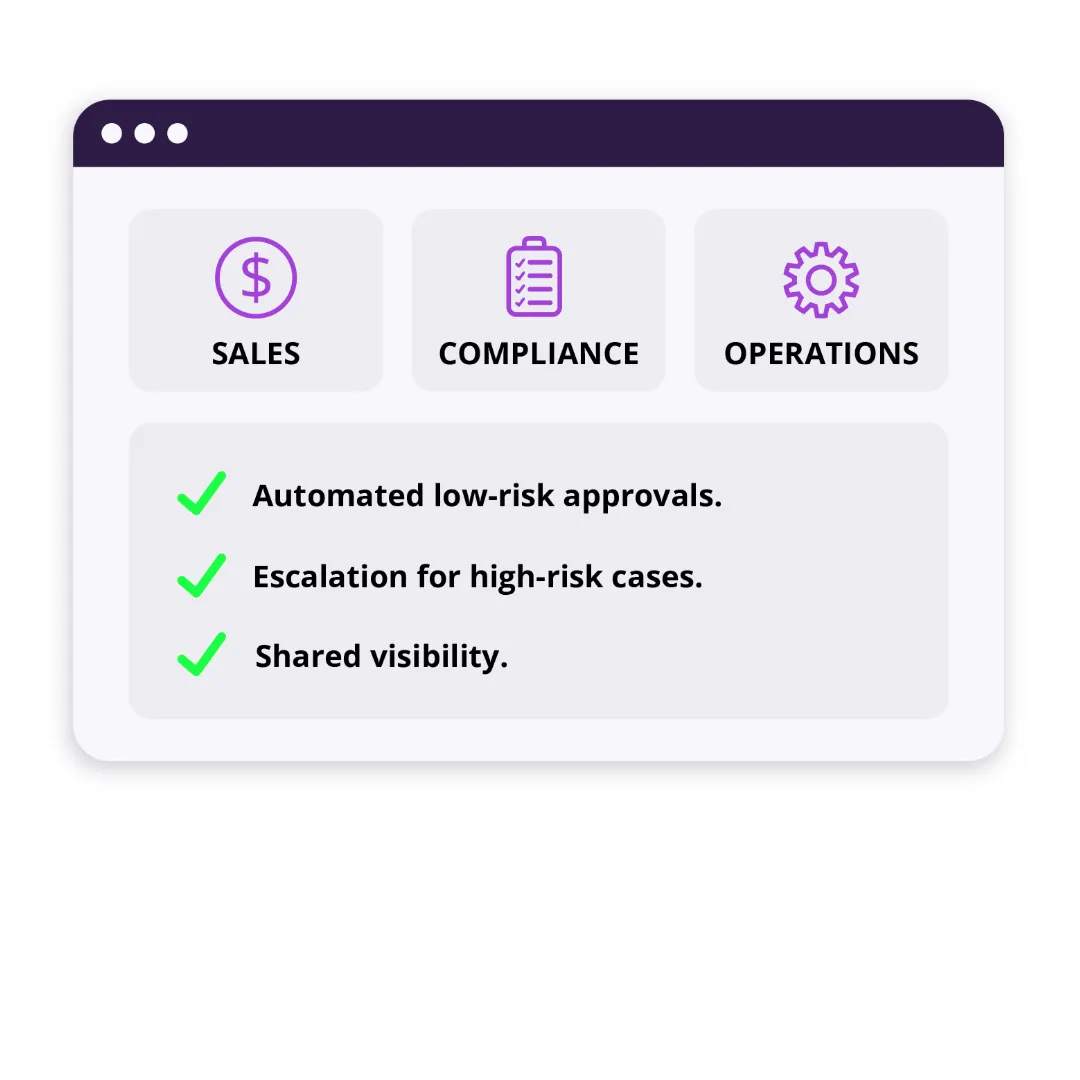
Not every merchant application needs the same level of manual review. Modern onboarding uses automation and predefined business rules to move routine, lower-risk applications through the appropriate checks while escalating complex or higher-risk cases.
This approach, known as management by exception, allows onboarding teams to focus on applications that genuinely need human judgement instead of manually reviewing every case.
For merchants, this means straightforward applications can move towards activation faster, without unnecessary waiting. For payment providers, it reduces manual workloads, improves consistency and helps teams manage higher application volumes without compromising risk controls.
5. Build complete audit trails into every onboarding decision
Every merchant approval should have a clear record of how the decision was made. Modern onboarding platforms automatically capture application details, verification results, risk assessments, reviewer actions, approvals and escalations as they happen.
Instead of searching through emails, spreadsheets and separate systems, teams can follow the complete history of an application in one place.
This makes it easier for payment providers to review decisions, identify gaps and demonstrate how onboarding controls were applied. With clear, traceable records, teams can respond to audits and regulatory reviews without spending hours rebuilding the decision history.
6. Scale onboarding across partners, brands and jurisdictions
White-label merchant onboarding helps payment providers grow through partners, resellers and regional channels by offering branded merchant onboarding journeys while keeping compliance, risk and approvals centrally controlled.
From one platform, providers can configure partner products, regions, pricing, branding and communications. They can also control smart forms, KYB, KYC, AML screening, enhanced customer due diligence (enhanced CDD), risk scoring, approval workflows, contracts, ongoing monitoring and partner reporting.
Partners get a tailored onboarding experience, while payment providers maintain central control without building separate systems or expanding their teams for every new partner.
7. Extend onboarding into ongoing customer due diligence
Merchant risk doesn't disappear once a business starts accepting payments. Ownership, business activities, transaction patterns and risk profiles can change throughout the relationship.
Modern onboarding carries the original merchant risk assessment into ongoing customer due diligence (OCDD) automatically. Monitoring tools can flag changes in ownership, screening status or transaction activity, helping teams identify when a merchant needs another review instead of relying entirely on manual checks.
This gives risk and compliance teams a clearer view of merchant activity after activation, helping them respond to emerging risks and keep merchant information up to date.
Together, these capabilities make end-to-end merchant onboarding faster, more consistent and easier to manage. But not every platform delivers the same level of control and automation.
So, how can Australian payment providers identify the right solution? The following checklist highlights what to look for.
How to choose the right merchant onboarding platform in Australia
Not every merchant onboarding platform delivers a complete end-to-end experience. Some handle individual tasks well but still leave payment providers managing separate systems and manual processes.
Use this checklist to compare merchant onboarding solutions and see how well their features work together:
- Dynamic smart forms: Can onboarding forms adapt to different Australian business structures, such as sole traders, companies and partnerships, and support business verification through sources like ABN Lookup and ASIC?
- KYB, KYC and AML checks: Can the platform support applicable AUSTRAC customer due diligence requirements, including beneficial ownership checks, PEP and sanctions screening, and enhanced customer due diligence (enhanced CDD) where required?
- Merchant underwriting: Can the platform assess expected transaction volumes, fraud and chargeback risks, and credit exposure, with risk scoring and approval decisions connected to each merchant application?
- Real-time integrations and AI: Can APIs connect Australian business registries, identity verification services, credit bureaus and sanctions-screening providers, while AI-assisted tools help reduce manual checks and speed up decisions?
- Automated onboarding: Can routine applications progress automatically while complex, incomplete or higher-risk cases are flagged for human review?
- Audit trails and governance: Does the platform automatically record verification results, risk assessments, reviewer actions and approvals, making every decision easy to trace?
- White-label and partner onboarding: Can providers configure branding, products, pricing, smart forms, compliance checks, approval workflows and reporting across different partners while maintaining central control?
- Merchant experience and activation: Can merchants easily apply, upload documents and track their progress? Can approved merchant information flow into payment setup without repeated data entry?
- Ongoing customer due diligence: Can the platform monitor changing merchant risks, trigger alerts and support ongoing reviews throughout the merchant relationship?
Don't just rely on a list of features. Ask vendors to demonstrate a real merchant onboarding journey, including how they handle missing information, risk alerts, approvals and payment activation.
This will help you see where the platform genuinely reduces manual work and where your teams may still need to step in.
Make merchant onboarding a competitive advantage
Merchant onboarding in Australia should be simple for merchants and easy for payment providers to manage. Merchants want to start accepting payments quickly, while providers need to manage risks, meet regulatory requirements and keep costs under control.
With an end-to-end approach, payment providers can reduce delays, make onboarding easier for their teams and give merchants a better experience. They can also handle more applications without constantly adding staff or increasing costs.
OnBoard by MVSI is an end-to-end merchant onboarding and compliance platform for regulated payments, fintech, and financial services, combining digital onboarding, KYB, AML screening, underwriting, and ongoing due diligence (OCDD) in one system. It connects automated checks, risk intelligence and human oversight so payment providers can make informed, traceable decisions and build trusted merchant relationships over time.
Ready to make merchant onboarding faster and easier? Explore OnBoard by MVSI to see how it can help your business grow.
Disclaimer: This article is provided for informational purposes only and does not constitute legal, regulatory, compliance, or business advice. Regulatory obligations vary by jurisdiction, industry, and business model. Organizations should consult qualified legal, compliance, and risk professionals when designing or updating onboarding, KYB, KYC, AML, underwriting, and risk management processes.
Related Resources
Customer Onboarding in Australia
Learn how Australian payment providers streamline customer onboarding while meeting AUSTRAC, AML/CTF, and customer due diligence requirements.
Cheques Are Ending. Manual Merchant Onboarding Should Be Next
Australia's shift away from cheques signals the end of paper-based processes. Discover how payment providers can modernise onboarding, reduce friction, and improve compliance.
AML Compliance Is Expanding: What the 2026 Workforce Reforms Signal for Regulated Businesses
Discover what Australia's 2026 AML reforms mean for regulated businesses and why connected onboarding, due diligence, and governance are becoming regulatory expectations.
KYC Compliance: Legal and Regulatory Considerations in Australia
Understand Australia's KYC requirements, including identity verification, customer due diligence and ongoing monitoring, and how businesses can manage these checks more efficiently.
Frequently Asked Questions
What information do Australian payment providers need to onboard a merchant?
Payment providers typically collect business registration details, ABN or ACN information where applicable, ownership details, identity documents and expected transaction volumes. The exact information depends on the merchant's business structure, payment products and risk profile. More complex businesses may need additional documents and verification checks.
Can merchant onboarding platforms handle complex ownership structures in Australia?
Yes. Platforms like OnBoard by MVSI help Australian payment providers manage complex company and trust structures. OnBoard can automatically map business ownership, identify and verify beneficial owners, perform PEP and sanctions screening, and flag higher-risk cases for review. This gives teams a clearer picture of who owns or controls a business, without having to piece together information manually.
Do Australia's 2026 AML/CTF reforms apply to all payment providers?
No. AUSTRAC's AML/CTF obligations apply to businesses providing designated services with the required Australian connection. The reformed obligations began on 31 March 2026 for existing reporting entities, with transitional arrangements for certain initial CDD requirements. Payment providers must assess which obligations apply to their specific services.
How should Australian payment providers choose onboarding software for AML/CTF compliance?
Look for software that supports risk-based customer due diligence, beneficial ownership checks, PEP and sanctions screening, audit trails and ongoing monitoring. It should also allow providers to configure workflows around their applicable AUSTRAC requirements. Remember, the software supports compliance, but the payment provider remains responsible for meeting its obligations.
What should Australian acquirers look for in onboarding platforms for ISO partners?
Acquirers should look for white-label onboarding that lets each independent sales organisation (ISO) offer a branded merchant experience. The platform should also allow the acquirer to control partner products, pricing, permissions, KYB, AML checks, underwriting and approvals centrally. This helps acquirers grow their partner networks without managing separate onboarding systems.
How long does merchant onboarding take in Australia?
There is no fixed timeframe. Onboarding depends on the merchant's business structure, risk level, required verification checks and payment setup. Automated workflows can speed up straightforward applications, while complex ownership structures, missing documents or additional underwriting reviews may take longer.

