



Why basic if-this-then-that logic falls short, and how intelligent Smart Forms support trusted, no-touch merchant onboarding.
Many payment providers think their digital application forms are already smart. But are they really?
What they have are forms that show or hide fields. Forms that ask different questions based on a previous answer. Forms that replace static PDFs with a cleaner online experience.
That’s useful. But it’s not enough for trusted merchant onboarding.
In regulated onboarding, the real challenge isn’t simply what appears on the screen, it’s what happens behind it. Knowing which questions to ask is only the start. You also need to know what the answers mean, what data to call, what rules to apply, what workflows to trigger, and whether the applicant can move forward.
And that’s where the difference becomes clear. A conditional form might make an application easier to complete. But if the answers still need to be checked, passed between teams, and manually reviewed before anything can happen, how much has the onboarding process really improved?
Why aren’t conditional forms enough for merchant onboarding?
Basic conditional logic changes which questions and fields the applicant sees. A merchant selects "sole proprietor," and the ownership questions shrink. Then they pick a high-risk category, and more questions appear. The form adapts, showing what's relevant and hiding what isn't. That's worth doing. But it still stops at the screen.
Conditional logic doesn’t necessarily enrich the data an applicant gives you, assess the risk it implies, or start KYB, KYC, and AML workflows. On its own, conditional logic doesn't coordinate pricing, contracts, approvals, and fulfillment across the full onboarding process. Without the right systems working together, someone still has to do all that heavy lifting after the applicant clicks submit.
Yes, conditional logic improves the form experience. But onboarding orchestration improves the entire onboarding decision.
So how do you tell the difference between a form that's genuinely smart and one that just reacts to answers?
What happens after a merchant submits an application?
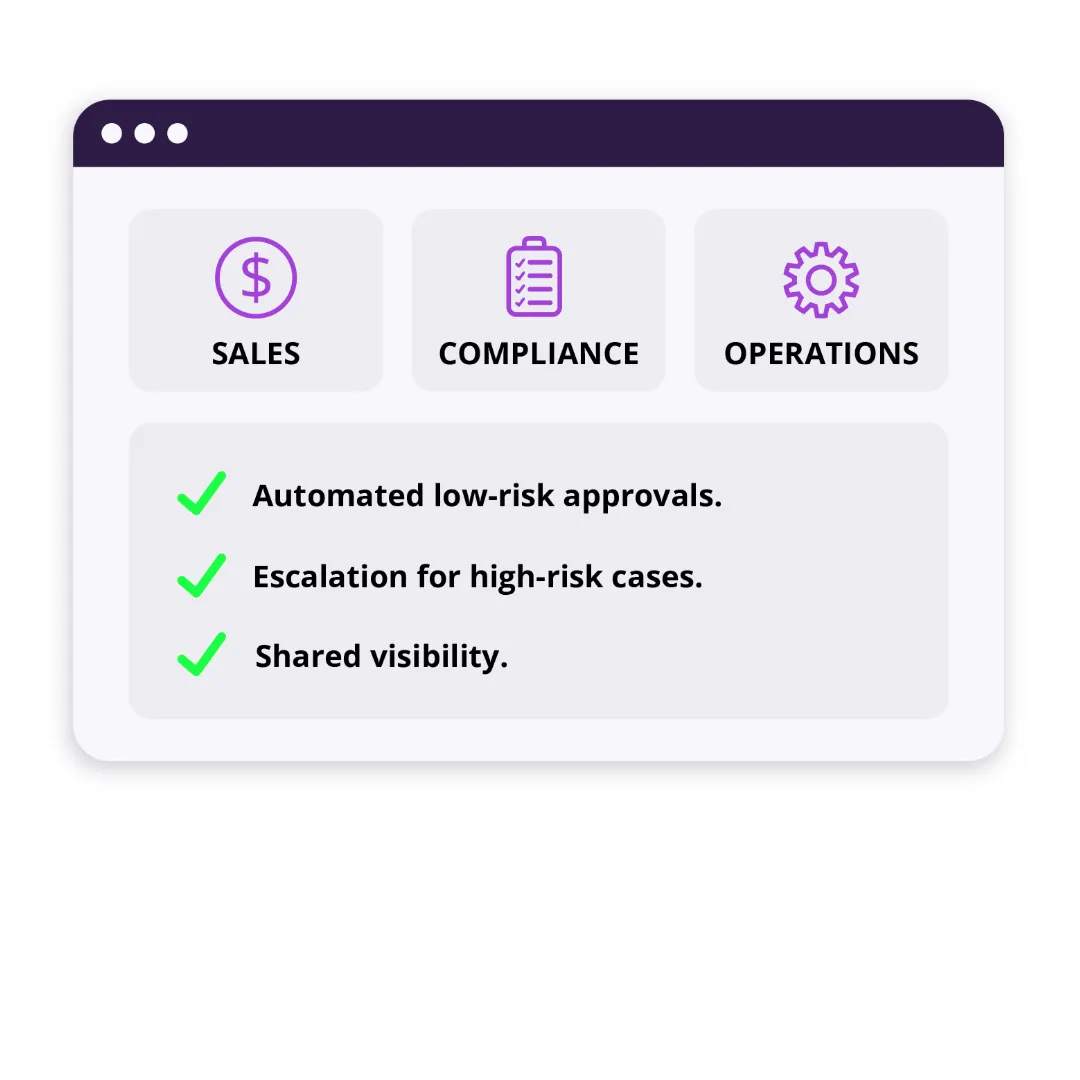
The answers should go straight into the right AML, KYC, and KYB workflows, with business and risk rules applied along the way. From there, the application should move toward approval, a request for more information, or further review. And you should be able to see what happened and why.
If the answers just land in an inbox or get passed between systems for someone to sort out manually, the form might be new. But the process behind it is not.
The real complexity sits behind the merchant application
And that's where things get complicated. Because once a merchant provides their information, there's a lot more to work out than whether they've filled in the right fields.
Think about what a payment provider needs to work out from a single merchant application. Is this product available to this type of business in this market? What pricing applies? Does the business model fit the provider's risk appetite? Which ownership and compliance requirements come into play? Does what the applicant said match what third-party sources show?
The tricky part? None of these decisions happen in isolation. A merchant's business model can influence which products they're eligible for, what pricing applies, and whether they fall within the provider's risk appetite. Their ownership structure might call for additional checks. And if information from a third-party source doesn't match the application, that's another question someone needs to resolve.
Now picture all of that happening across different teams and systems. Sales has one piece of the puzzle. Compliance has another. Underwriting is waiting on both. One missing detail turns into another email, another follow-up, another delay. Before you know it, a straightforward application has become a frustrating game of back and forth.
That's the problem with expecting a basic form builder to handle a much bigger job. It can collect the answers, but it doesn't necessarily connect the people, rules, and systems needed to make sense of them.
The form is only the visible layer. The value sits in the intelligence underneath.

What do true Smart Forms do differently?
The difference is what happens with the information. True Smart Forms for merchant onboarding don't just react to individual answers. They can pull data from third-party sources, check it against internal systems, and apply business and risk rules while the applicant is still filling out the form.
As Daniel Sheahan, CEO of MVSI, explains:
“It's that ability to correlate, examine, consume, calculate hundreds of data points instantly in real time.”
That's what makes them genuinely intelligent. One answer doesn't just change the next question. It can trigger a check, influence a risk or business decision, or determine where the application goes next. That's onboarding orchestration: connecting information, rules, and workflows so each step helps drive the next.
For example, how do Smart Forms work during merchant onboarding?
A merchant enters their business details. Instead of waiting until they hit submit, OnBoard Smart Forms can check the information against third-party sources, pull internal records, and trigger the right KYB, KYC, and AML workflows. If something doesn't add up, the form can ask for more information while the merchant is still there.
And it doesn't stop at compliance. The same process can apply risk-based routing, work out product eligibility and pricing, prepare offers and contracts, and route applications for approval, rejection, referral, or review. Clean data can then move straight to fulfillment and downstream systems.
Whether it's different products, markets, brands, or partners, the journey can adapt without starting from scratch. And because the information stays connected, it can also support ongoing due diligence long after the application is complete.
Smart Forms don't just collect answers. They help determine what those answers mean and what should happen next.
This sets the stage for risk-based onboarding, where each merchant gets the right level of checks and reviews based on their risk.
How do Smart Forms support risk-based onboarding?
With the information collected, extracted, and validated through Smart Forms, payment providers can build a clearer picture of each merchant's risk and adjust the onboarding journey accordingly.
Because let's face it, not every merchant should have to jump through the same hoops.
A low-risk merchant should move quickly. A higher-risk case should trigger deeper questions, document requests, enhanced checks, or human review. The difference is that each merchant follows a path that reflects their risk, rather than being held up by a one-size-fits-all process.
This is where intelligent automation makes speed possible without cutting corners.
Mastercard's 2024 digital merchant onboarding report found that PayFacs can onboard merchants in 5–15 minutes, compared with an average of 3–7 days for traditional acquirers in its study. But speed only matters if the right controls are still in place.
That's management by exception. Routine applications move through the required checks, while Compliance and Risk teams focus on cases that need their judgment. Less time chasing paperwork. More attention where it counts.
Smart Forms help teams reduce unnecessary friction without reducing control.
But passing the right checks is only part of the picture. The bigger question is whether those results give you enough confidence to onboard the merchant.
From verified checks to trusted onboarding decisions
Picture an applicant who passes everything. Identity check, clear. Sanctions screening, clear. Registry lookup, matches. Every indicator is green.
Sounds like a straightforward approval, right? Not necessarily.
There could still be questions worth asking. Does the business model fit the product being offered? Is the ownership structure what it appears to be? Is the expected volume consistent with the category?
This is the difference between verified and trusted. Verified means individual checks have passed. Trusted means the provider has enough confidence to onboard the merchant under the right risk, product, compliance, and operational conditions.
A conditional form can help gather the information. It doesn't create that confidence on its own. Trust comes from seeing the applicant in context: product, market, risk profile, business model, ownership, and compliance requirements together. That’s what orchestration provides. It turns fragmented verification into trusted decisioning.
Every modern merchant onboarding process should be able to answer one important question:
Can you show why a merchant was approved?
A provider should be able to see what information was reviewed, which checks were completed, and what rules led to the decision. All in one place, without having to chase down records or piece together answers from different systems.
If all you have is a list of passed checks, you know what was verified. But that doesn't necessarily tell you why the merchant was approved.
And that's a much harder question to answer when the information is scattered across different systems.
Why point solutions block no-touch onboarding
Many providers assemble onboarding from specialist tools. One collects the application. Another performs KYB. Another manages risk. Another generates contracts. Another handles fulfillment.
Connecting them with APIs moves data between tools. But getting those tools to work together is another story. When one system needs information another hasn't collected, someone still has to step in and sort it out.
Daniel Sheahan, CEO of MVSI, puts it simply:
“Point solutions are one of the biggest barriers to achieving no-touch onboarding. ”
His point? Each tool might do its job well. But if they can't work together, teams are left filling the gaps. That's when manual work creeps back in.
Here’s how that breaks: an applicant finishes the form at 4 p.m. and leaves. Three days later, the KYB tool flags a missing ownership document. Someone emails the applicant. By then, the applicant has moved on. Meanwhile, a team member reconciles records across systems by hand.
What could have been sorted out during the application has now become another round of follow-ups, delays, and cost.
No-touch doesn't mean no people. It means people step in where judgment is needed, not to patch gaps between tools. That requires the journey to stay connected from first question to final outcome. Point solutions create handoffs.
Orchestration creates momentum.
For more on this, see OnBoard's piece on Smart Forms and real-time risk engines.
Why Smart Forms need an end-to-end onboarding platform
Smart Forms create the most value when they connect to the full journey. After all, intelligent intake can only take you so far if the rest of the onboarding process can't act on that information.
A modern onboarding platform needs to unify digital intake, KYB and KYC, AML screening, risk assessment, underwriting, approvals, contracts, fulfillment, and ongoing due diligence (OCDD) in one workflow.
OnBoard by MVSI brings these capabilities together in an end-to-end merchant onboarding and compliance platform for regulated payments, fintech, and financial services. Its Smart Forms act as the intelligent front door to the wider process. The information they collect can trigger and inform risk assessments, underwriting, approvals, and contracts, before moving into fulfillment. That same information can also support ongoing due diligence, without teams having to start from scratch at every stage.
That's when Smart Forms become more than an intelligent application. They become the starting point for an entire onboarding process that can move forward with the right information already in place.
The business impact of connected Smart Forms
The value isn’t just a better form. It is a faster, smarter, more scalable onboarding operation.
Take Nayax Australia. With OnBoard by MVSI connecting Smart Forms, compliance checks, and reseller onboarding in one platform, Nayax reduced merchant onboarding time by 98%. Its network of more than 100 partners has also onboarded over 8,000 businesses.
Another leading payments provider saw similar results. After moving to OnBoard's connected onboarding platform, it cut time to activation by 12 days and onboarded more than 15,000 applications without human intervention.
These aren't just improvements to the application form. Both case studies show what becomes possible when onboarding can handle growing merchant volumes without the same increase in manual work. Instead of adding more people to manage every application, payment providers can focus their teams on the cases that actually need attention.
For payment providers, that means less friction, lower operational pressure, and a faster path to revenue. For merchants, it means spending less time waiting and more time doing business.
Smart Forms are not conditional forms
Conditional logic has earned its place. It shortens forms, cuts irrelevant questions, and makes the applicant's first few minutes easier. Keep it.
But it was never built to carry a regulated onboarding decision. That takes more than collecting answers. It takes the right information, the right checks, and the right decisions working together.
That's the real difference. A conditional form makes the application easier to complete. A true Smart Form helps move the entire onboarding journey forward, from the first question to merchant activation.
Trusted onboarding isn’t the result of one passed check. It's about having the full picture, knowing when to act, and having the confidence to make the right decision.

