


.png)

Verification has become faster, smarter, and more sophisticated.
Payment providers can confirm identities, validate businesses, screen for sanctions, assess fraud signals, and complete Know Your Business (KYB) and Anti-Money Laundering (AML) checks faster than ever.
Yet merchant onboarding still slows down.
Applications still move between teams. Exceptions still trigger manual reviews. Compliance still chases missing context. Sales teams still wait for decisions.
The problem is not verification. It is expecting individual checks to make the whole onboarding decision.
The payments industry has spent years investing in stronger compliance controls, more sophisticated fraud detection, and specialist risk technologies. These investments have improved individual parts of the process, but they haven't solved one of the industry's biggest challenges: scaling merchant onboarding without increasing complexity.
If verification has become smarter than ever before, why do so many payment providers still struggle with manual reviews, operational bottlenecks, merchant friction, and growing merchant drop-off?
Verification has not failed. It remains essential. But verifying individual data points is not the same as deciding whether the full merchant relationship represents acceptable risk.
As merchant onboarding becomes more complex, payment providers need to move beyond isolated checks and rethink how they make onboarding decisions. Verified means individual checks have passed. Trusted means the provider has enough evidence, context, and control to decide whether the merchant can move forward, under what conditions, and with what level of oversight. Providers that connect verification to risk policies, approvals, provisioning, and ongoing monitoring can scale without forcing every application through the same manual process.
OnBoard by MVSI is built around that broader decision. It is an end-to-end merchant onboarding and compliance platform for regulated payments, fintech, and financial services, combining digital onboarding, KYB, KYC, AML screening, underwriting, approvals, and ongoing customer due diligence in one system.
OnBoard connects those capabilities to the policies, workflows, and human oversight needed to make trusted onboarding decisions at scale.
Key Takeaways
- Verification alone cannot scale merchant onboarding because individual checks do not provide the complete context needed to assess merchant risk and make confident onboarding decisions.
- Siloed merchant onboarding models increase operational complexity, creating manual reviews, duplicated work, higher costs, merchant drop-off, and slower approvals despite continued investment in verification and compliance technology.
- Trusted merchant onboarding connects verification, risk, compliance, and business context, giving teams the information they need to make faster, more consistent, and more defensible decisions.
- End-to-end merchant onboarding platforms support sustainable growth by bringing people, processes, automation, approvals, and governance into one connected workflow.
Verification is essential, but it is not the full onboarding decision
Moving beyond verification does not mean replacing it. It means recognizing where verification ends and the onboarding decision begins.
Identity verification, KYB, KYC, AML screening, sanctions and PEP screening, document checks, and fraud detection are essential inputs to merchant onboarding. They help providers validate applicants, identify financial crime exposure, and meet regulatory and scheme obligations.
Verification validates data. It does not make the full onboarding decision.
A KYB result may confirm that a business exists. A KYC check may confirm an individual's identity. An AML or sanctions screen may return no match. None of those results, on its own, determines whether the complete merchant relationship should be approved.
The full decision may also depend on the merchant's business model, ownership structure, website activity, products, transaction profile, geography, expected volumes, credit exposure, scheme requirements, commercial terms, and the provider's own risk appetite.
In response to new risks and regulatory requirements, many providers have added specialist tools for identity, KYB, sanctions, documents, fraud, risk scoring, and workflow management. Each may improve one part of the process. The operating challenge begins when teams must reconcile those outputs before deciding what happens next.
The problem is not a lack of checks. It is the gap between those checks and the operational decision.

The cost of disconnected verification
Verification costs become harder to control when every check creates another handoff, review queue, integration, or manual reconciliation step.
Instead, payment providers continue to invest heavily in verification, compliance, and financial crime prevention, yet the cost of onboarding continues to rise. According to LexisNexis Risk Solutions' 2023 True Cost of Financial Crime Compliance Report, financial institutions bear more than US$206 billion in annual financial crime compliance costs globally, with many firms reporting rising compliance costs across major markets such as the UK and Australia.
Mastercard research reinforces this point. Traditional acquirers need US$250 to US$350 on average to process a merchant application while meeting regulatory and scheme requirements.
The issue is not simply the cost of a check. It is the cost of the operating model around the check: the handoffs, reviews, data reconciliation, and manual decision-making that slow onboarding at scale.
Multiply that cost across thousands of new merchants, and growth quickly becomes an expensive operational challenge rather than a competitive advantage.
As Daniel Sheahan, CEO of MVSI, explains, "Not investing enough is a problem. Investing too much can also waste money and resources. Achieving scale is about finding the right balance."
The issue is not insufficient verification. It is the absence of a scalable operating model that connects verification results to risk policies, approvals, exception handling, provisioning, and ongoing monitoring.
Even the strongest verification tools cannot, by themselves, coordinate sales, compliance, underwriting, risk, legal, operations, partner channels, merchant communications, contracting, activation, and OCDD. Scaling requires those functions to operate through a shared workflow and decision record.
The hidden cost of siloed merchant onboarding
The scaling problem becomes clearer when the full operating model is considered.
As risk and regulation have evolved, providers have added specialist teams and technologies for KYB, KYC, AML, sanctions, fraud, credit, underwriting, documents, and workflow management. These investments often strengthen individual functions. They can also leave the overall onboarding process fragmented.
Compliance focuses on regulatory obligations. Fraud teams look for suspicious behavior. Risk and underwriting assess exposure. Sales prioritizes conversion and speed. Operations teams need complete, accurate information to activate the merchant.
Merchants do not experience those departments separately. They experience one provider, one application, and one path to activation.
As Daniel Sheahan, CEO of MVSI, explains, "Most organizations still operate in silos. Each business unit gets the tools, processes, and people it needs. The secret to onboarding at scale isn't optimizing individual business units. It's designing around the customer's journey."
Point solutions are valuable at what they are built to do. A KYB platform verifies a business. An identity provider verifies an individual. A sanctions service screens names. A fraud engine surfaces suspicious signals.
The scaling problem begins when teams must manually reconcile those outputs before anyone can decide what happens next.
The same fragmentation can appear across external sales channels. ISOs, agents, resellers, and regional partners may own the merchant relationship, but the provider still needs consistent risk policies, KYB, AML screening, underwriting, approvals, and monitoring.
This is the difference between verified checks and a trusted onboarding decision.
A merchant can pass every verification check and still create uncertainty. Identity is verified. AML screening is complete. Fraud checks are clear. Yet no one has connected those signals to answer the question that really matters:
Can we trust this merchant to move forward?
Trust doesn't come from one verification result. It comes from bringing identity, business ownership, transaction profile, automated risk assessment, AML and fraud outcomes, historical activity, compliance obligations, and commercial context into a governed onboarding decision.
This is why payment providers can keep investing in verification and compliance technology while still struggling to scale. Specialist tools can improve individual checks, but when those results sit across separate systems and teams, someone still has to reconcile the evidence before a decision can be made.
The providers that scale merchant onboarding will be those that connect every signal, team, and decision in one governed workflow, from application and verification through approvals, activation, and ongoing monitoring. That is what turns verification into trusted onboarding: faster movement for straightforward applications, clearer escalation for exceptions, and stronger control without adding more operational complexity.

What trusted merchant onboarding decisions require
Building trust requires more than individual verification checks. It requires a merchant onboarding solution that brings people, processes, risk data, policy rules, and decision context together throughout the onboarding journey.
The following capabilities form the foundation of a more connected and scalable approach to merchant onboarding.
- End-to-end onboarding: Trusted merchant onboarding should connect every stage of the journey, from contract generation and smart application forms through to KYB, KYC, AML screening, underwriting, approvals, provisioning, activation, and ongoing customer due diligence (OCDD). The goal is not simply to move data between tools. It is to give every team one managed process for turning an application into a live, governed merchant relationship.
- Rules-based decision automation: Automation should reinforce an organization's own policies, risk appetite, and governance framework, ensuring decisions remain consistent as onboarding volumes increase.
- Risk-based approvals and exception handling: Allow low-risk merchants to move quickly while routing incomplete, unusual, or higher-risk cases to the right specialist with the relevant evidence and decision history.
- Document interpretation and validation: Organizations should be able to interpret, validate, and extract information from complex business documents automatically without relying on time-consuming manual reviews.
- Unified compliance verification: Automated KYB, KYC, AML, PEP and sanctions screening should work as one connected workflow, helping teams build a more complete view of the merchant's risk profile rather than relying on fragmented verification results.
- Digital merchant intelligence: Merchant assessment should extend beyond submitted information to include website analysis and online business activity, helping identify hidden risks before onboarding is complete.
- Transparent decision governance: Every automated action, risk assessment, and onboarding decision should be fully traceable, providing a clear audit trail for internal governance and regulatory review.
- White label onboarding: Scale merchant acquisition through ISOs, agents, resellers, regional partners, and specialist channels while keeping KYB, AML screening, underwriting, approval rules, risk policies, workflows, reporting, provisioning, and OCDD centrally controlled. Partners can deliver a professional branded journey, while the provider maintains one governed onboarding operation across multiple brands, products, partner groups, regions, and languages.
- Ongoing customer due diligence: Monitor relevant changes in ownership, sanctions exposure, adverse media, business activity, or other risk indicators after activation, and trigger the appropriate review workflow when risk changes.
- Human expertise where it adds the most value: Automation should remove repetitive work, allowing risk and compliance specialists to focus on complex decisions that require professional judgment.
- Approval-to-activation execution: Connect the decision to contracts, conditions, merchant communications, provisioning, downstream systems, and activation so an approved application becomes a governed, operational merchant relationship.
Trusted merchant onboarding is not the accumulation of more checks. It is the controlled process that turns those checks into an approval, escalation, decline, request for information, activation, or monitoring action.
When evidence, policies, approvals, human review, and operational actions are connected, providers can process more applications without treating every merchant as an exception.
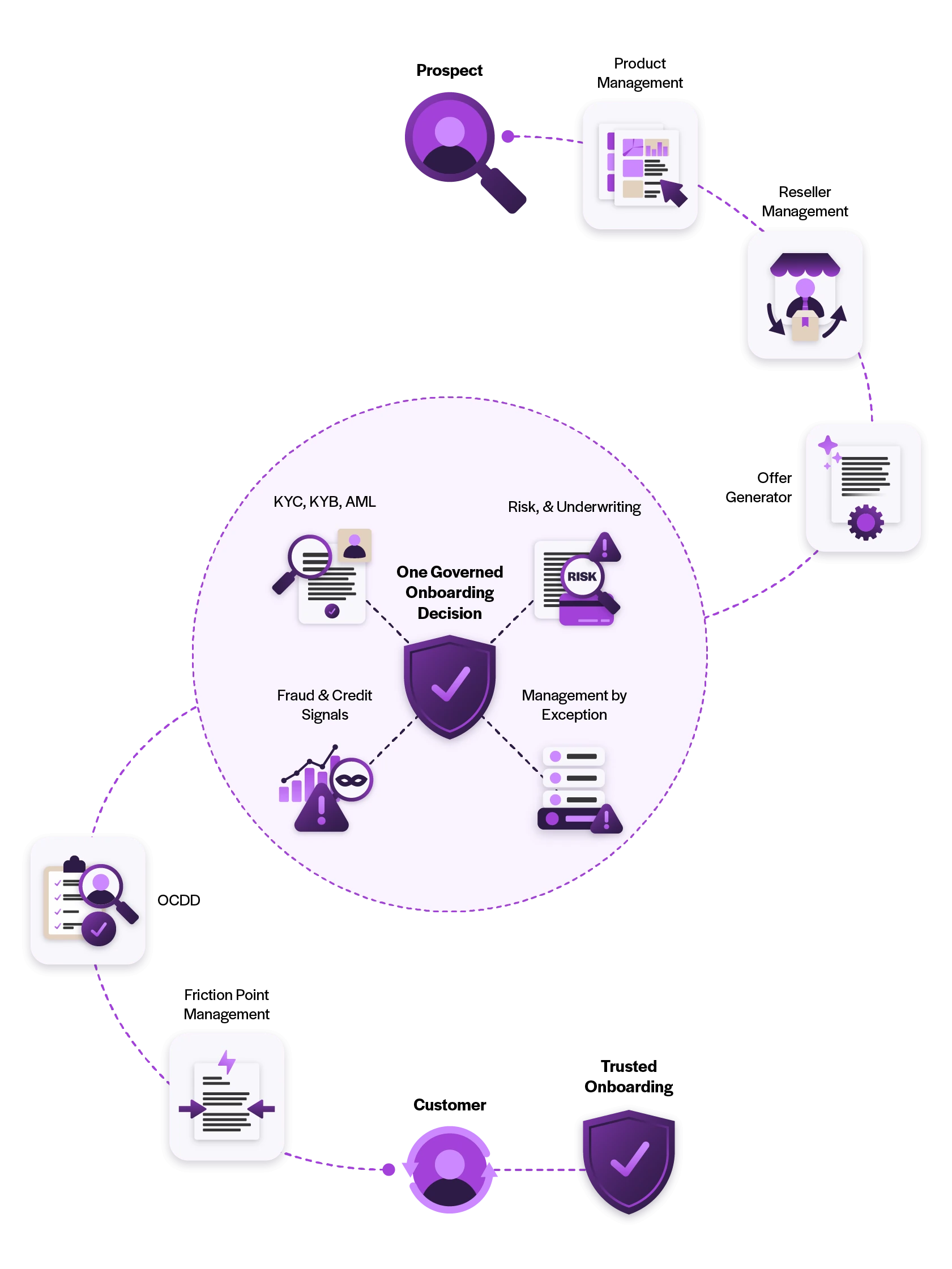
Scaling merchant onboarding requires trusted decisions
The payments industry still needs strong verification. What it cannot afford is verification that remains disconnected from the rest of the onboarding decision.
Adding another tool may improve one check while creating another integration, queue, or reconciliation step. Scale comes from connecting the evidence to policy rules, approvals, exception handling, activation, and ongoing monitoring.
That's the difference between verifying merchants and making trusted onboarding decisions.
Adding more checks in isolation will not solve the problem. Providers will scale by connecting verification, risk, compliance, approvals, and oversight into decisions they can explain, defend, and repeat.
Speed without control creates risk. Control without automation creates bottlenecks.
Payment providers need an operating model that connects the full merchant onboarding lifecycle, from application and verification to risk, compliance, approvals, partner workflows, provisioning, activation, and OCDD.
OnBoard by MVSI is an end-to-end merchant onboarding and compliance platform for regulated payments, fintech, and financial services, combining digital onboarding, KYB, KYC, AML screening, underwriting, approvals, provisioning, and ongoing customer due diligence in one system.
OnBoard helps regulated businesses move beyond isolated checks to trusted onboarding decisions across compliance, risk, approvals, white label workflows, provisioning, and OCDD.
For payment providers, acquirers, PayFacs, and regulated financial services businesses, that means faster movement for straightforward applications, clearer escalation for exceptions, and stronger control across the full merchant lifecycle.
In one payments provider implementation, OnBoard helped turn manual merchant onboarding into a scalable growth engine. The provider shortened customer time-to-live by 12 days, engaged 100% of merchants within the first 24 hours, and supported more than 15,000 applications through a faster, more consistent onboarding model.
Book a demo to see how OnBoard can simplify compliance, accelerate merchant activation, and support governed growth across teams, partners, brands, and regions.
Disclaimer: This article is provided for informational purposes only and does not constitute legal, regulatory, or compliance advice. Merchant onboarding, AML, and risk management requirements vary across jurisdictions. Organizations should seek appropriate professional advice when designing or reviewing their onboarding and compliance processes.
Frequently Asked Questions
Why isn't verification alone enough to scale merchant onboarding?
Verification confirms individual facts, such as identity, company registration, beneficial ownership, sanctions exposure, or document validity. Merchant onboarding requires a broader decision about whether the full relationship represents acceptable risk. At scale, providers also need policy rules, approvals, exception handling, provisioning, auditability, and OCDD connected to those checks.
What is the difference between verification and a trusted onboarding decision?
Verification means that individual checks have passed. A trusted onboarding decision means the provider has enough evidence, context, and control to approve, escalate, decline, provision, request more information, or monitor the merchant under its own policies and risk appetite. The decision should also be explainable and supported by a clear audit trail.
How can payment providers make trusted onboarding decisions at scale?
Payment providers can scale trusted onboarding by connecting applications, KYB, KYC, AML screening, underwriting, risk assessment, approvals, exception handling, provisioning, and OCDD in one governed workflow. Low-risk merchants can move quickly, while higher-risk or incomplete applications are routed to the right team with the evidence needed for review.
Why can point solutions make merchant onboarding harder to scale?
Point solutions can improve individual checks, but each tool may introduce another integration, output, queue, or review step. When teams must manually reconcile KYB, KYC, AML, fraud, document, and risk results, onboarding becomes slower and harder to govern. An end-to-end platform connects those results to the full decision and activation process.
What role does OCDD play in trusted merchant onboarding?
Ongoing customer due diligence helps providers reassess merchant risk after activation. Changes in ownership, sanctions exposure, adverse media, business activity, or other risk indicators can trigger reviews or updated controls. This ensures the onboarding decision remains current rather than relying on a one-time snapshot.
How does white label merchant onboarding support partner-led growth?
White label merchant onboarding allows ISOs, agents, resellers, and regional partners to deliver a consistent branded journey while the provider retains central control over KYB, AML screening, underwriting, risk policies, approvals, reporting, provisioning, and OCDD. It supports channel growth without duplicating onboarding infrastructure.
What is an end-to-end merchant onboarding and compliance platform?
An end-to-end merchant onboarding and compliance platform manages the process from application and data collection through verification, risk assessment, underwriting, approvals, contracting, provisioning, activation, and ongoing monitoring. It connects compliance checks to the complete operational decision rather than treating them as isolated tasks.

