


.png)

No-touch merchant onboarding starts with intelligent intake. Smart Forms capture and validate the right data from the beginning, allowing payment providers to trigger risk-based checks and workflows while moving straightforward merchants forward faster.
You can’t automate a poor intake process. And by the time most businesses realize they have one, the merchant is already waiting.
Payment providers, acquirers, payment facilitators (PayFacs), and Independent Sales Organizations (ISOs) all share the same blind spot when it comes to merchant onboarding automation: teams routinely hunt for delays in the wrong places. But by then, the damage is already done. The wrong questions have been asked. The wrong data has been captured. And a merchant application that should have moved quickly is already carrying gaps downstream.
Then everyone downstream is left to pick up the pieces. Sales chases missing information. Compliance asks for another document. Risk waits for the context it needs. Operations deal with another exception. And the merchant? They’re still waiting.
Capgemini's World Payments Report 2026 found that bank merchant onboarding can take up to seven days and cost up to $496 per merchant, while digital-first PayTechs can enable merchants to go live in under 60 minutes for as little as $214. The same research found that 69% of merchants expect fast, seamless onboarding, but only 13% of banking executives believe their institutions can deliver it. No-touch onboarding doesn’t start at approval. It starts with the first question.
Key Takeaways
- No-touch onboarding starts at intake. The information captured at the beginning determines how the application progresses through KYB, KYC and AML screening, risk assessment, underwriting, and approval.
- Static application forms create downstream friction. Asking every merchant for the same information leads to unnecessary fields, incomplete applications, manual follow-up, and slower onboarding.
- Smart Forms turn intake into a decisioning layer. Intelligent intake adapts the journey, validates and enriches application data, applies business rules, and determines what should happen next as the merchant progresses.
- Better intake enables risk-based onboarding. Clean, structured data allows straightforward merchants to move toward straight-through processing while higher-risk or inconsistent applications are routed for human review.
- Intelligent intake works best as part of a connected onboarding process. The data and decisions created at intake should continue through risk assessment, underwriting, approvals, fulfillment, and ongoing due diligence.
Why static application forms fail merchant onboarding
Wrong questions drive wrong data. Most digital application forms were never designed for how onboarding actually works today. They're paper processes that got moved onto a screen. Someone wrote down what information was needed, and someone else translated that list directly into a web form with no intelligence added anywhere along the way. That approach collects information, but it doesn't guide the applicant, validate what's entered, or adapt to how much risk that particular merchant actually represents—the opposite of what dynamic application forms are built to do.
That becomes a problem when every merchant is asked to follow the same path. Rigid, uniform merchant applications force low-risk applicants through the exact same battery of questions as high-risk accounts. Submissions routinely return incomplete or inconsistent, triggering cycles of repeated document requests and manual follow-up that stall progress across sales, compliance, risk, and operations teams in equal measure. Every irrelevant question or unnecessary field adds friction and gives the merchant another reason not to finish.
By the time a merchant reaches the application, Sales and marketing have already created momentum. The application should protect it, not turn interest into administration.
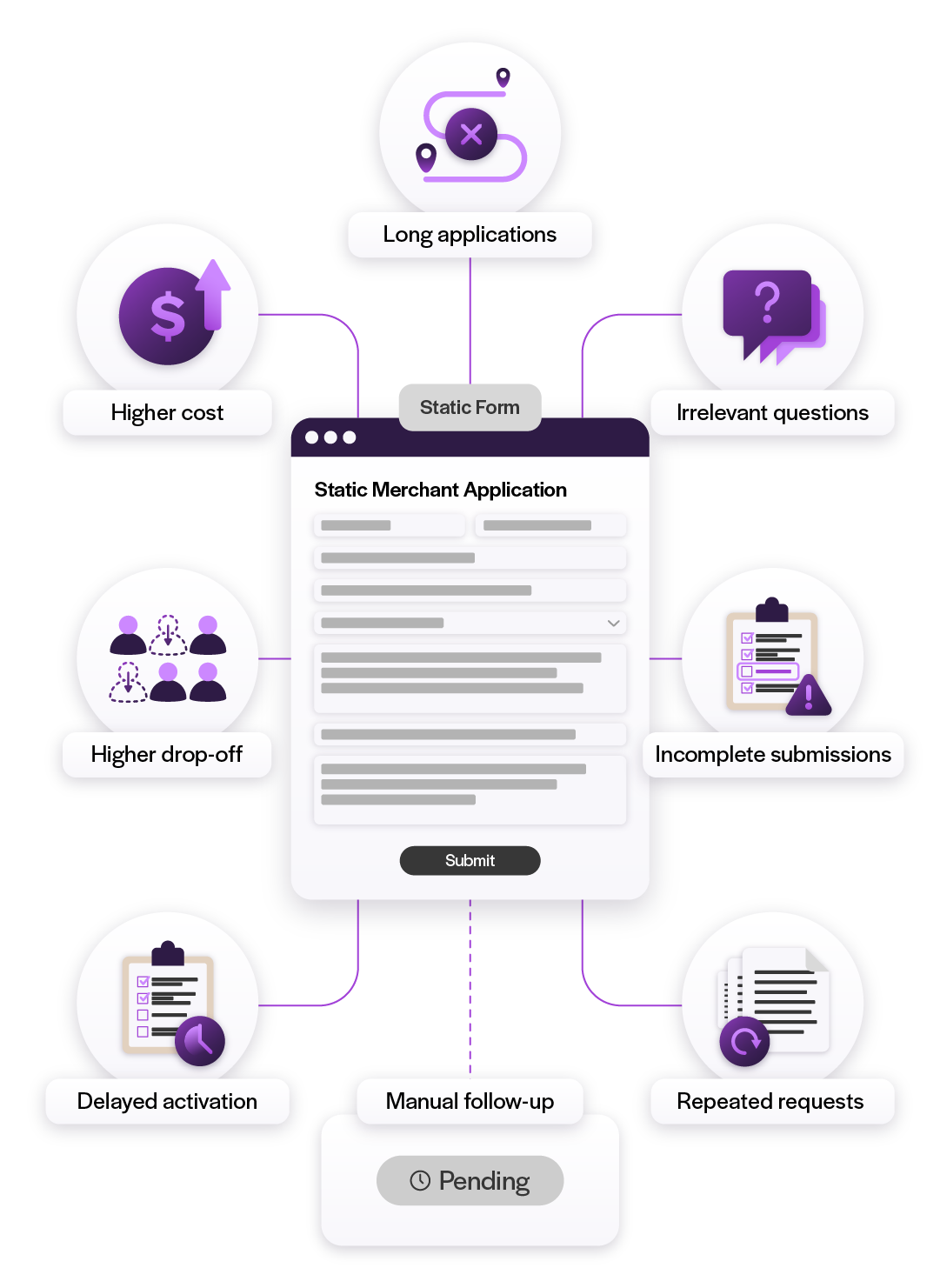
The scale of the problem is particularly visible in enterprise onboarding. McKinsey found that a typical corporate client onboarding can require up to 100 documents and 150 data fields, while KYC due diligence and account opening consume more than 40% of the time a customer spends onboarding. When the process already asks this much of an applicant, asking for information that isn't relevant only makes a difficult experience harder.
Heavy intake forms are often a symptom of outdated fraud and risk infrastructure. Capgemini's World Payments Report 2026 found that 65% of bank payment executives reported using outdated credit-risk and fraud-detection models, while 56% said they lacked automated pre-screening using public, financial, and business data. When infrastructure cannot assess risk as the application develops, providers may compensate by asking for more upfront: more questions, more fields, more documents, and more for the merchant to get through.
The result is an experience that feels as heavy as the infrastructure behind it. Only about 24% of corporate businesses describe their merchant services onboarding process as very easy.
That’s the problem with static forms. They ask for everything upfront because they have no way of knowing what matters yet. Intelligent intake turns that around. Start with the right question, and every answer can shape what gets asked, checked, or triggered next.
Why the first question matters
Every field should earn its place. The first question a merchant answers should shape what happens next: what they’re asked, what data is collected, which checks are triggered, and which workflows start. Get that first question right, and the journey can adapt from the start.
That matters because every unnecessary question creates another reason to stop. A low-risk merchant shouldn’t be dragged through a journey built for a high-risk one. The longer the form, the more momentum you lose.
A Smart Form should feel like part of the product experience, not an administrative hurdle added after it. It should guide the merchant through what is relevant to them while collecting the information the business actually needs.
The first answer should start doing the work immediately. It can trigger a check, validate information, or start a workflow while the merchant is still engaged.
People expect the version of onboarding that Amazon trained them to expect everywhere else: log in, choose what you want, and have it sorted that afternoon, not across 27 separate interactions spread over two weeks. Smart Forms ask what’s needed, validate what’s entered, and trigger what happens next. That’s what enables straight-through processing for qualified, low-risk applicants, while exceptions are still routed for the right level of review.
What Smart Forms do differently
A digital form collects answers. Smart Forms for merchant onboarding work differently. They use those answers to shape the application journey, determine the level of scrutiny required, and decide how the merchant should progress. That’s intelligent intake.
This goes well beyond a form builder that can show or hide a field based on a single answer. The difference is what happens behind the form. Intelligent intake reads applicant inputs, applies business rules, and orchestrates internal and third-party data, correlating hundreds of individual data points in real time to determine what should be asked, checked, or triggered next.
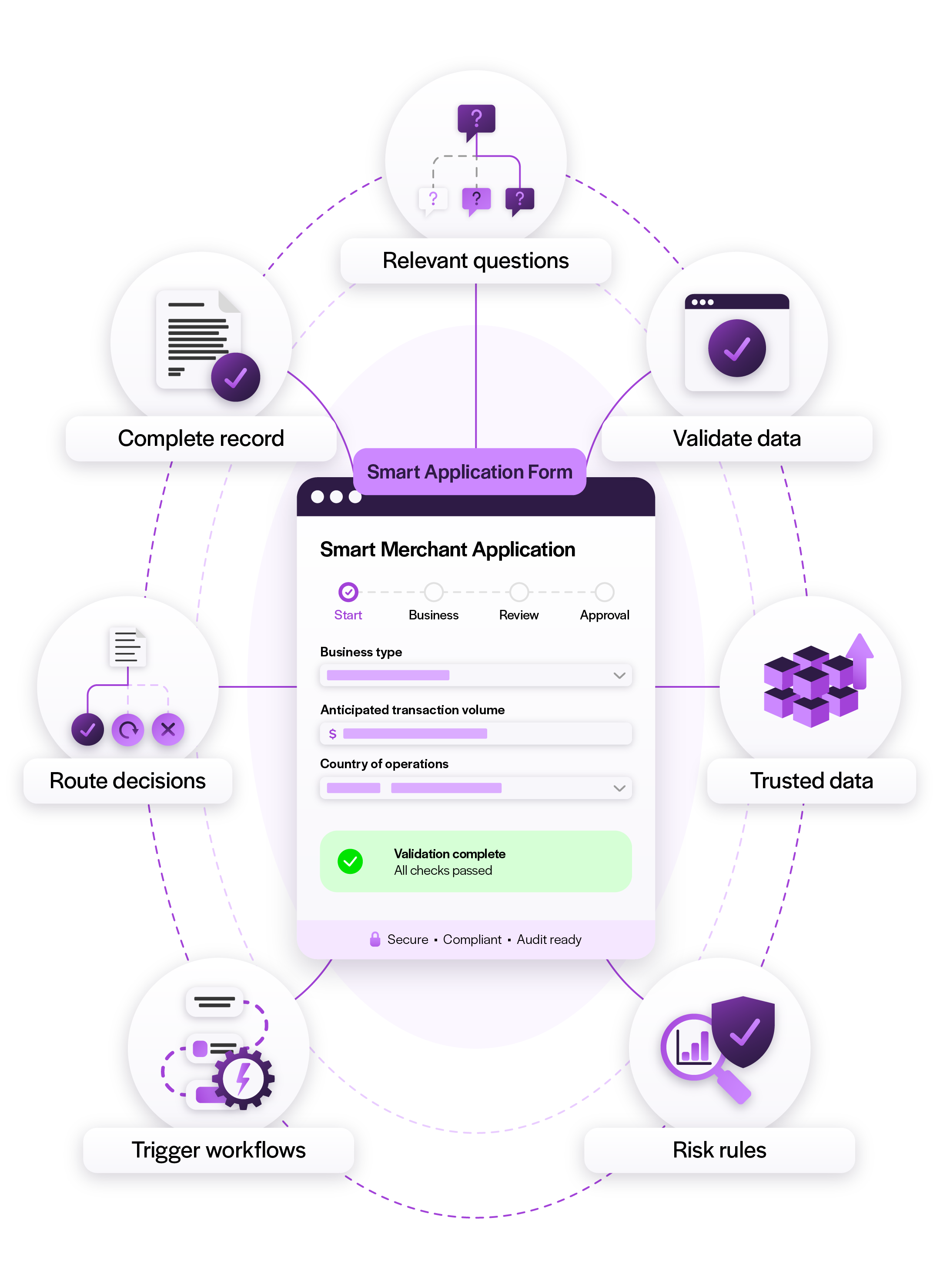
As one example, assessing a brand-new business applicant might mean pulling how long the company has been registered from a central registry, reading uploaded bank statements, and validating and cross-referencing all of it against the answers already on the form. That happens in real time, while the merchant is still ready to move, not after the application has landed in another review queue.
That same intelligence works just as hard on the commercial side as it does on risk. Take a merchant looking to accept payments online and in-store. Based on what they select, their expected transaction volume, and predefined business rules, the application can guide them toward the relevant payment package or product options. The merchant gets a clearer path to what they actually need, without having to work it out from a long list of services.
That becomes even more important when the product itself is complex. A merchant shouldn’t have to navigate 27 options and sub-options just to work out what applies to them. The complexity can sit behind the form, while the merchant sees only the questions and choices relevant to their journey.
The form can even recognize a US-based applicant from their device and IP, serve the correct regional brand and product set, and carry that context straight through to fulfillment, without asking the applicant to specify their own country twice.
This is what a genuinely intelligent front door looks like. One controlled entry point that adapts by product, market, brand, partner, region, language, channel, customer type and risk profile, not a separate form for every combination. Along the way, it triggers KYB, KYC, and AML workflows, calls third-party data sources, applies risk-based routing, shapes offers and pricing, and syncs the result into the systems that need it. One form. Many journeys. Complete control from the first question.
That same flexibility can support white-label merchant and ISO onboarding, giving selected ISOs, agents, resellers, or regional partners a professional branded onboarding journey while the payment provider keeps KYB, KYC, AML, risk rules, underwriting, approvals,
From verified checks to trusted onboarding decisions
Passing individual checks isn’t the same as being ready to onboard someone. Trusted onboarding begins before the application is even submitted.
Verified means individual checks have passed. Trusted means the provider has enough context, evidence, and control to decide whether the full merchant profile represents acceptable risk under the right product, compliance, and operational conditions.
KYB, KYC, and AML checks are critical inputs, but they are not the full onboarding decision.
In practice, a trusted onboarding decision gives the business enough confidence to approve, escalate, request more information, decline, provision, or move the merchant into ongoing monitoring according to its own policies and risk appetite.
A merchant can pass a check and still leave important questions unanswered.
Who owns the business, what it sells, where it operates, and how it expects to process payments can change the picture even when individual checks come back clean. It’s that wider context that turns a series of passed checks into something more valuable: trust in the decision to onboard.
How Smart Forms make no-touch onboarding possible
Good merchants shouldn’t be slowed down by high-risk workflows. But automation can only move as fast as the information supporting the decision. Complete, structured application data gives providers the context to apply risk-based onboarding from the start.
That means every merchant application no longer has to take the same path. Straightforward, low-risk merchants can move toward straight-through processing, while unusual, inconsistent, or higher-risk applications are routed for a closer look by a human.
That’s what no-touch onboarding is really about. It doesn’t remove human judgment; it makes sure that judgment is used where it matters most. Compliance, Risk, Sales, and Operations can spend less time chasing routine applications and more time on the cases that genuinely need their attention.
Where that judgment is needed isn’t left to chance. Payment providers set the rules, risk thresholds, and conditions that determine what can move straight through and what needs a closer look. That keeps automation within the provider’s own risk appetite and compliance requirements, without pulling people into every decision.
The benefit is not simply faster processing. It is helping trusted merchants move forward without unnecessary delay. Across MVSI OnBoard customer implementations, customers have reported reductions in time to revenue of around 30%, as intelligent intake helps suitable merchants progress from application to activation faster while exceptions receive the scrutiny they need.
But Smart Forms can only take the journey so far. If the data and decisions they create run into disconnected systems or manual handoffs, the momentum stops. Smart Forms need to be part of the end-to-end merchant onboarding journey, connected to the systems and workflows that carry the merchant forward.

Why Smart Forms need a connected onboarding platform
Smart Forms shouldn’t sit at the edge of the merchant onboarding process. The data and decisions made at intake become far more valuable when they carry into every stage that follows. Otherwise, an intelligent front door can quickly lead into the same disconnected processes businesses were trying to escape.
Modern onboarding platforms need to unify digital intake, KYB/KYC, AML screening, risk assessment, underwriting, approvals, contracts, fulfillment, and ongoing due diligence (OCDD) in one workflow. That means the information collected at the first question can keep informing the next check, decision, and action, without teams having to rebuild the picture at every stage.
Point solutions can verify individual parts of an application. Orchestration layers can connect checks and risk signals. An end-to-end onboarding platform goes further by carrying those signals into the wider merchant operation, from underwriting and approvals through provisioning and monitoring.
The distinction is what happens after those checks. Risk and compliance signals only create operational value when they inform whether the merchant moves forward, under what conditions, and what action should happen next.
You see the difference when something changes mid-journey. If an underwriter needs another document or Compliance needs more information, a connected journey can bring that request back to the merchant without losing the context already built around the application. With disconnected point solutions, that can quickly become another handoff, another chase, and another delay.
Merchant onboarding does not end at compliance approval. It ends when the right merchant is live, governed, and monitored.
The trusted merchant profile built during onboarding can then carry forward into ongoing due diligence, giving teams continuity as the relationship and risk profile evolve over time.
OnBoard by MVSI is an end-to-end merchant onboarding and compliance platform for regulated payments, fintech, and financial services. It connects Smart Forms and digital onboarding with KYB, KYC, AML screening, risk assessment, underwriting, approvals, contracts, fulfillment, and OCDD in one governed workflow.
Smart Forms act as the intelligent front door to that wider lifecycle, allowing the data and decisions created at the first question to keep informing what happens through approval, provisioning, monitoring, and ongoing compliance.
The business impact of intelligent intake
The real cost of poor onboarding is revenue. Every merchant stuck chasing documents, answering unnecessary questions, or waiting for another review is a merchant that isn’t processing yet. Push that friction too far, and they may never start.
Intelligent intake changes that equation. When applications arrive with the context needed to make a decision, teams spend less time reconstructing the merchant profile and more time acting on it.
As Daniel Sheahan, CEO of MVSI, puts it, the goal is to present compliance teams with "everything they need to make that decision upfront." That shifts their time away from assembling routine applications and toward the cases where expert judgment adds the most value.
The same impact reaches Risk and Fraud. When the information and analysis they need arrives earlier, teams can spend less time building the picture and more time protecting the business.
That’s the business case: lower attrition, faster time to revenue, lower operational cost, and stronger risk and compliance decisions, without making good merchants pay for that control with a painful onboarding experience.
Frictionless onboarding is the new standard
No-touch onboarding can't be built on top of static forms, no matter how much automation gets layered onto the back end. It has to start earlier than that.
Intelligent intake is the foundation the rest of onboarding is built on, not a feature bolted onto the front. It allows the application itself to adapt, validate, enrich, and route information before downstream teams have to intervene. Businesses that treat their application form as the first decisioning layer, rather than a data-collection formality, are the ones building onboarding that scales without creating new risk in the process.
Most providers still go looking for their onboarding problem downstream, in the queue, the review stage, the approval backlog. But if the first question was wrong, no amount of fixing further down the line closes that gap. The fix starts where the process starts.
No-touch onboarding starts with the first question.
Disclaimer: This article is provided for general informational purposes only and does not constitute legal, regulatory, compliance, or financial advice. Merchant onboarding, KYB, KYC, AML, underwriting, and ongoing due diligence requirements vary by jurisdiction, industry, business model, and risk profile. Organizations should seek appropriate legal, compliance, or professional advice when designing or reviewing their merchant onboarding processes.
Frequently Asked Questions
Why does no-touch onboarding start with the first question?
No-touch onboarding starts with the first question because the information captured at intake determines which rules, checks, and workflows can be applied as the application develops. When that information is complete and relevant, straightforward merchants can move toward automated processing while exceptions and higher-risk applications are escalated for review.
How do Smart Forms support no-touch merchant onboarding?
Smart Forms support no-touch merchant onboarding by capturing structured data, validating information, and triggering checks and workflows as the merchant progresses. This enables straightforward, low-risk merchants to move toward straight-through processing while unusual, inconsistent, or higher-risk applications are routed for human review.
What is the difference between static and dynamic merchant application forms?
Static merchant application forms typically send every merchant through the same questions regardless of their circumstances or risk profile. Dynamic application forms can adapt the journey based on the information provided, helping reduce unnecessary questions, incomplete submissions, repeated document requests, and manual follow-up, and the risk of merchant application abandonment.
What makes Smart Forms different from basic conditional forms?
Basic conditional forms typically show or hide fields based on predefined answers. Smart Forms for merchant onboarding go further by combining applicant responses with business rules, internal and third-party data, validation, risk signals, and workflow triggers to determine what should happen next. Within OnBoard by MVSI, that intake can continue directly into KYB, KYC, AML screening, underwriting, approvals, fulfillment, and OCDD.
Why should Smart Forms connect to the wider merchant onboarding process?
Smart Forms are most effective when the data and decisions created at intake continue through the wider merchant onboarding process. Connecting intake with KYB, KYC, AML screening, risk assessment, underwriting, approvals, fulfillment, and ongoing due diligence reduces manual handoffs and allows information captured at the beginning to keep informing later decisions

