


.webp)

Know Your Customer (KYC) improves customer security, accelerates onboarding, and enables more personalized financial services through identity verification, fraud prevention, and automated compliance processes within digital onboarding workflows.
As digital and financial services become increasingly interconnected, the need for strong security measures to protect both businesses and customers continues to grow. KYC is one of those measures. Once viewed primarily as a compliance requirement, KYC has evolved into an important part of improving security, simplifying onboarding, and supporting more personalized financial services.
KYC is far more than a regulatory checkbox. It verifies customer identities, ensuring that only legitimate individuals gain access to financial services, which in turn bolsters transaction security and helps guard against fraud and identity theft. It also smooths the onboarding process, cutting down on delays and improving the user experience. As the importance of KYC continues to grow, it’s clear how these processes are shaping a more secure, efficient, and personalized financial environment.
Key Takeaways
- KYC strengthens customer security by reducing fraud, identity theft, and unauthorized access through identity verification and risk assessment processes.
- Digital KYC streamlines onboarding through remote identity verification and automated compliance checks, helping customers access services more quickly.
- Trust and transparency improve when financial institutions can verify identities and maintain secure customer relationships.
- Verified customer data enables more personalized financial products, services, and digital experiences tailored to individual needs.
What is KYC?
KYC is an essential process that businesses, especially in the financial and digital sectors, use to verify their customers' identities. It involves confirming personal information—like names, addresses, and financial histories—using official documents, biometric data, and risk assessments. KYC is not just a regulatory requirement; it’s also a vital security measure designed to protect both businesses and customers.
Key Components of KYC
KYC involves several key steps to verify a customer’s legitimacy:
- Document Verification: Customers submit government-issued IDs, such as a passport, national ID card, or driver’s license, to verify their identity.
- Biometric Authentication: Technologies like facial recognition or fingerprint scanning provide additional layers of protection to confirm a customer’s identity.
- Risk Assessment: Financial institutions review transaction patterns and customer backgrounds to spot potential risks like fraud, money laundering, or terrorism financing.
Regulatory Frameworks and Compliance
KYC is fundamental to regulatory frameworks like Anti-Money Laundering (AML) and Combating the Financing of Terrorism (CFT). Bodies like the Financial Action Task Force (FATF) guide these frameworks, ensuring businesses follow thorough due diligence to prevent financial crimes. For customers, KYC means engaging with institutions committed to transparency, security, and legal compliance.
Why KYC Matters for Customers
KYC is a crucial safeguard against fraud, identity theft, and financial crime. It ensures that only verified individuals can access financial services, reducing the risk of fraud, such as account takeovers or unauthorized openings. Without KYC, criminals could exploit weaknesses across financial systems, creating exposure for both businesses and consumers. KYC checks play a pivotal role in safeguarding customers from financial crime and strengthening trust in financial systems.
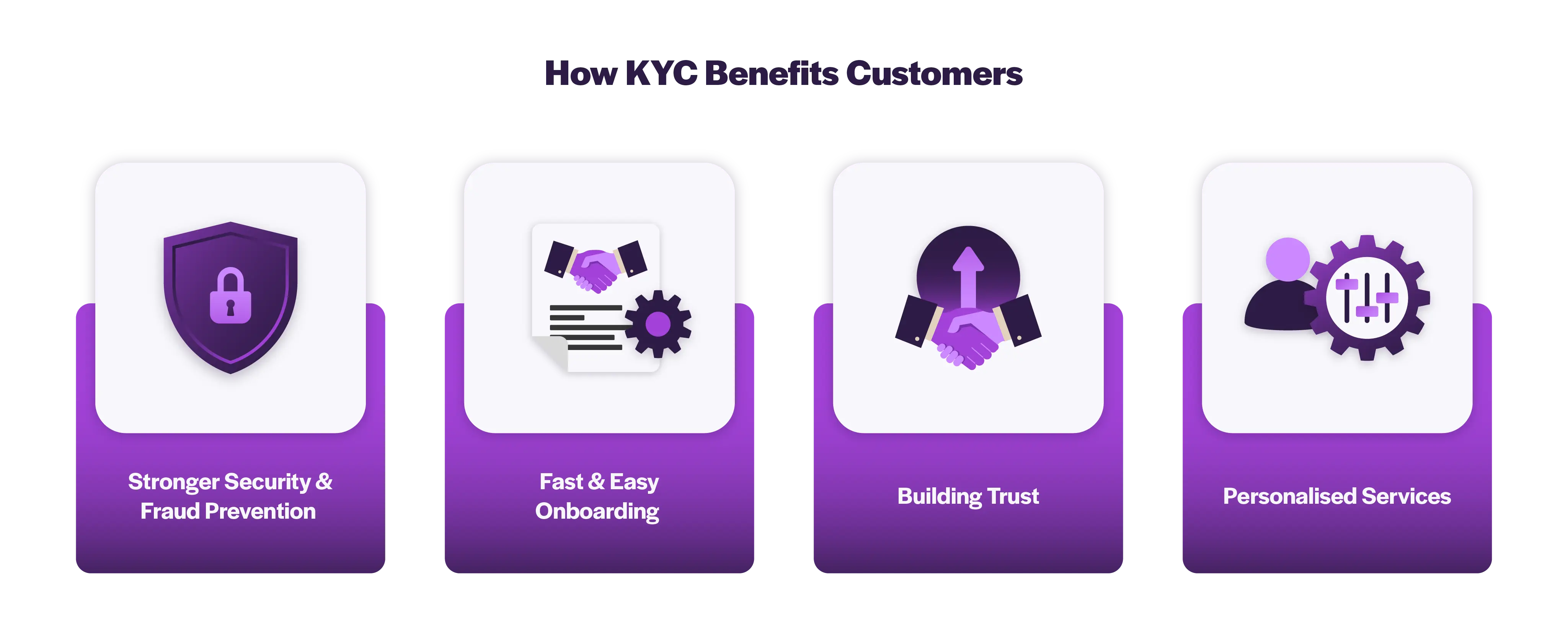
KYC Benefits for Customers
Enhancing Security & Preventing Fraud
KYC is essential in strengthening security and reducing fraud, especially in an era where cybercrime and identity theft are on the rise. Financial institutions and digital services are constantly targeted by criminals who exploit weak verification processes to access sensitive accounts. By ensuring only verified individuals can access these services, KYC plays a crucial role in safeguarding against fraudulent activity.
One of the key KYC benefits is its role in preventing synthetic identity fraud, a growing concern, particularly in the U.S. This type of fraud involves creating fake identities using a mix of real and fabricated information. Solutions like real-time document verification, biometric authentication, and AI-driven risk assessments help identify and block these fraudulent identities before they can do any damage.
Furthermore, AI-powered KYC systems can detect suspicious patterns in user behavior, allowing businesses to address potential fraud before it escalates. By adopting stringent KYC procedures, financial institutions not only protect their customers but also safeguard their own financial stability.
Faster and Smoother Onboarding
The days of tedious paperwork and long waiting times for financial service onboarding are gone. Digital KYC has streamlined the process, allowing customers to verify their identities remotely and access services almost immediately. This shift significantly improves the customer experience while meeting the demand for speed and convenience in today’s digital landscape.
For instance, platforms like Revolut have revolutionized onboarding with AI-powered KYC, reducing the entire process to a matter of minutes. Customers simply upload documents and use biometric verification to confirm their identities, eliminating the delays typical of traditional methods. This approach is especially beneficial for industries like cryptocurrency exchanges, digital wallets, and online payments, where time is crucial. The result is not only higher user satisfaction but also greater retention thanks to a seamless, hassle-free experience.
Building Trust with Financial Institutions
Trust is at the heart of any financial relationship. Customers need confidence that their financial service providers are secure, transparent, and committed to protecting their personal data. KYC helps establish that trust by ensuring only legitimate users can access services, creating a secure environment for all transactions. By verifying identities and preventing unauthorized access, KYC strengthens the integrity and security of financial interactions.
Take Estonia’s e-Residency program, for example. Entrepreneurs can start businesses remotely, but first, they must undergo a rigorous KYC process. This ensures security while also building trust in the digital ecosystem. Verified identities help businesses forge stronger, more secure relationships with customers, leading to long-term loyalty and engagement.
Across the financial sector, strong KYC practices send a clear message to customers that their chosen providers prioritize security and transparency, further solidifying trust.
Personalized Financial & Digital Services
KYC goes beyond compliance—it also unlocks the potential for personalized financial services. Once a customer’s identity is verified, businesses gain valuable insights into their financial habits, preferences, and needs, enabling them to offer tailored services that enhance customer satisfaction.
For example, banks can use KYC data to suggest personalized investment options, lending products, or credit solutions based on individual financial profiles. Similarly, fintech companies can offer customized payment solutions or rewards programs to better align with customers’ specific preferences. This shift toward hyper-personalization not only improves the customer experience but also fosters greater engagement and satisfaction.
By leveraging verified data, businesses can move beyond generic offerings and provide relevant, customer-centric solutions that align with users' financial goals. This personal approach makes customers feel understood and valued, helping to build deeper connections with financial institutions.
Automation & Digital KYC in Improving Customer Experience
Advancements in automation and AI are transforming KYC processes, making them faster, more accurate, and less disruptive for customers. AI-driven KYC systems are redefining how institutions verify identities, creating a process that’s both more efficient and secure. Here’s how:
- Instant Verification: AI and machine learning enable real-time identity checks, reducing onboarding times and providing near-instant access to services.
- 24/7 Availability: Automated KYC systems operate continuously, allowing customers to verify their identities and access services at any time.
- Better Accuracy: AI can identify fraudulent activity or inconsistencies that may be missed during manual reviews, improving verification accuracy.
The Rise of e-KYC (Electronic KYC)
e-KYC takes things further by enabling entirely digital identity verification. This eliminates the need for physical documents or in-person visits, offering a more convenient process for customers. With e-KYC, users can verify remotely, using just their smartphones or computers. This is especially useful for those in underserved or remote regions who might not have easy access to physical banking services. e-KYC is also a crucial player in global financial inclusion, helping businesses extend services to wider, often unbanked, populations.
A prime example of this is India’s Aadhaar-based e-KYC system, which has empowered millions to access financial services remotely through biometric data, without relying on traditional paperwork.
How KYC Automation Improves Customer Experience
KYC automation improves the customer experience by streamlining identity verification, making onboarding faster, more secure, and more efficient.
It also strengthens security through AI-powered fraud detection, helping identify suspicious activity throughout the onboarding process and reducing the risk of identity theft.
Additionally, automated compliance checks make it easier for businesses to meet regulatory requirements like Anti-Money Laundering (AML) and Countering the Financing of Terrorism (CFT), without interrupting the customer experience. This creates a more seamless process for both businesses and customers while balancing compliance requirements with user convenience.
In practice, these KYC and compliance processes are increasingly managed within end-to-end onboarding platforms, where identity verification, risk assessment, and ongoing compliance checks are integrated into a single workflow to improve efficiency and customer experience.
Conclusion
KYC is evolving from a simple regulatory obligation into a fundamental part of security, efficiency, and customer experience across digital financial services. As the industry moves towards more digital solutions, KYC has evolved beyond basic identity verification into a broader part of digital onboarding, fraud prevention, compliance, and customer experience strategy.
With the rise of AI, machine learning, and biometric verification, KYC processes are becoming quicker, smoother, and more accessible. These innovations not only strengthen protection against fraud but also create more efficient and personalized customer experiences. Automated solutions are enabling businesses to deliver services that are more efficient, accessible, and easier for customers to navigate.
Looking ahead, KYC will remain a crucial defense against fraud, identity theft, and financial crime. At the same time, it will continue to shape a more customer-focused financial landscape, where trust, security, and personalization take center stage. The future of KYC lies in finding the right balance between robust protection and a seamless user experience, giving customers the best of both security and convenience in their digital financial interactions.
This content is provided for general informational purposes only and does not constitute legal or regulatory advice. KYC, AML, and compliance requirements may vary by jurisdiction and organization.
Frequently Asked Questions
What are the benefits of E-KYC?
E-KYC improves onboarding speed by allowing customers to verify their identities digitally through remote document checks, biometric authentication, and automated compliance processes. It reduces paperwork, improves accessibility, and creates a faster, more convenient customer experience.
What are the benefits of Re-KYC?
Re-KYC helps ensure customer information remains accurate and up to date for AML and CFT compliance. It supports fraud prevention, improves transparency, and helps financial institutions maintain accurate risk assessments over time.
What are the benefits of KYC automation?
KYC automation improves onboarding speed by enabling faster identity verification and reducing manual errors. Automated compliance checks help businesses maintain AML and CFT requirements, while AI-driven monitoring strengthens fraud detection and transaction security.

