


.png)

Financial crime, particularly money laundering, remains a growing concern for businesses worldwide. As financial systems become more complex and digital, criminals are quick to exploit new weaknesses, making it harder for organizations to protect themselves. The stakes are high—companies risk not only significant financial losses but also severe penalties and lasting harm to their reputation.
Without up-to-date anti-money laundering (AML) and fraud prevention strategies, businesses are vulnerable to regulatory scrutiny and compliance failures. Traditional, manual methods are no longer enough. Digital onboarding solutions are stepping in as crucial tools to tackle this issue. These platforms automate essential compliance tasks, such as transaction monitoring and customer due diligence, enabling businesses to keep pace with the increasingly sophisticated methods of financial crime.
Within digital onboarding, AML risk management is applied through identity verification, customer due diligence, and transaction monitoring to assess and control risk from the outset of the customer relationship.
This article looks at how digital onboarding solutions can help reduce the risks of money laundering, boost compliance, and provide long-term advantages for businesses.
Key Takeaways
- Digital onboarding enhances AML risk management by automating due diligence, transaction monitoring, and risk detection processes.
- Strong AML controls reduce exposure to financial crime, regulatory penalties, and reputational damage.
- Technologies such as AI and machine learning improve detection accuracy and enable faster responses to suspicious activity.
- Integrating digital onboarding into AML strategies improves operational efficiency while maintaining consistent compliance standards.
Understanding Money Laundering Risks
Money laundering poses significant risks to organizations, from financial losses to lasting reputational damage. As criminal methods become more sophisticated, businesses of all sizes are increasingly vulnerable to exploitation. Understanding these risks and their broader impact is crucial for safeguarding an organization’s financial stability and reputation.
Why Are Organizations Targeted?
Organizations of all sizes are prime targets for money laundering schemes, driven by ever-evolving criminal tactics and vulnerabilities within their systems. Criminal networks have become more sophisticated, using technologies like digital wallets and cryptocurrencies to conceal illicit activities. Without proper safeguards, businesses are at risk of exploitation, particularly when compliance systems fail to keep up with these evolving methods.
A major factor in this risk is the lack of awareness within organizations. As financial crime becomes increasingly complex, many businesses continue to rely on outdated manual processes that can't keep pace. Financial crime syndicates are now operating more strategically, layering illicit funds across multiple accounts and jurisdictions, making detection even more challenging.
The Impact of Money Laundering
Financial Consequences
The financial impact of money laundering is significant. Organizations can suffer direct losses from fraudulent activities, but also face substantial fines and penalties for failing to comply with Anti-Money Laundering (AML) regulations. Global fines for AML violations exceeded $50 billion since the 2007 financial crash, highlighting the severe financial risks involved.
Beyond fines, the costs of investigations, legal fees, and potential asset forfeiture can drain resources that could otherwise be invested in growth and innovation. According to a 2023 UN study, money laundering activities account for up to 5% of global GDP annually, underscoring the vast financial scale of the issue.
Reputational Damage
The reputational fallout from being involved in money laundering activities can be even more damaging than financial losses. Customers and investors expect transparency and security from organizations. When an organization becomes associated with criminal activities, trust is eroded, and rebuilding that reputation can take years.
A 2018 PwC survey found that 58% of businesses reported reputational damage as the most significant consequence of financial crime. As consumer and investor confidence declines, organizations may struggle to retain clients and secure new partnerships. Over time, these reputational challenges can severely impact a company’s bottom line and future prospects.
The Importance of AML Risk Management
AML risk management is a critical component of safeguarding organizations, ensuring compliance while actively preventing financial crime. Following AML regulations ensures businesses stay on the right side of the law and avoid significant fines. More crucially, strong AML practices create a transparent and trustworthy environment, building confidence with customers, partners, and regulators. By taking a proactive approach to combat financial crime, companies protect their reputation and reinforce long-term stability.
Global standards set by organizations like the Financial Action Task Force (FATF) aim to prevent illicit financial activities. Adopting these standards helps reduce the risks of financial crime and contributes to a more secure and ethical business environment.
The Consequences of Non-Compliance
Not implementing effective AML measures can lead to severe consequences in several areas:
- Financial Penalties: Non-compliance can result in hefty financial penalties. In 2022, regulators imposed over $2 billion in fines on Danske Bank for AML violations. Such fines often surpass the cost of putting in place a solid AML programme, highlighting the financial risks of ignoring compliance.
- Legal Risks: Organizations that fail to meet AML requirements face increased regulatory scrutiny, which can lead to legal action, criminal charges, and costly investigations.
- Reputational Damage: Non-compliance can significantly undermine customer trust and investor confidence, with long-term impact on business performance.
By ensuring AML compliance, organizations can mitigate these risks, protect their financial health, and maintain a strong position in a competitive market.
How Digital Onboarding Mitigates AML and Fraud Risks
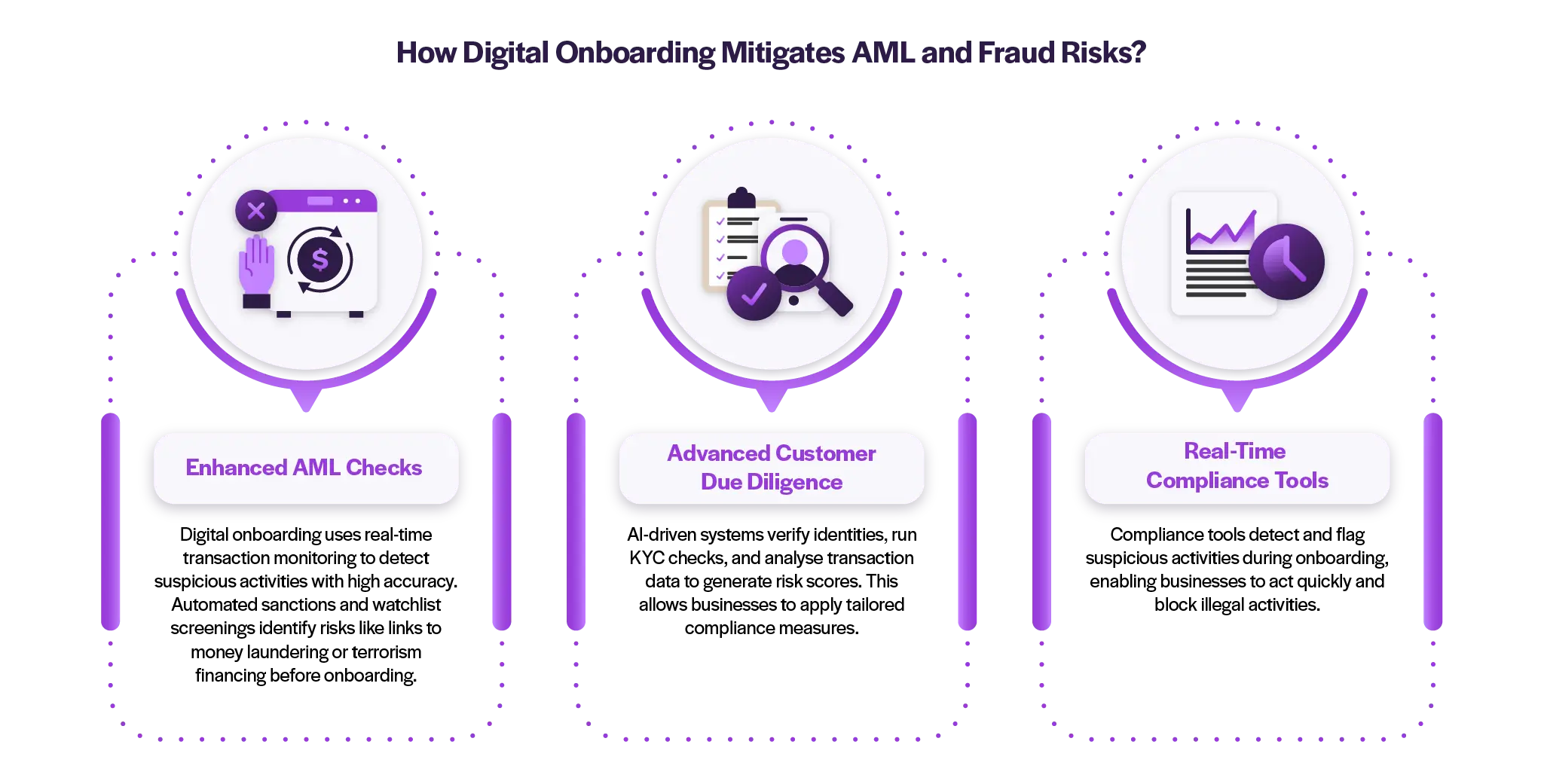
As financial crime risks evolve, businesses need to adopt smarter tools to protect themselves from money laundering and other illicit activities. Digital onboarding solutions provide a powerful way to strengthen AML compliance by streamlining verification processes and detecting risks before they escalate.
- Enhanced AML Checks
Digital onboarding solutions automate real-time transaction monitoring, identifying suspicious activities with precision, strengthening both AML and fraud prevention efforts. By integrating automated sanctions and watchlist screening, these systems ensure compliance with global AML regulations. They flag potential risks, such as links to money laundering or terrorism financing, before onboarding, preventing illegal transactions. - Advanced Customer Due Diligence
AI-driven platforms play a vital role in verifying customer identities, conducting KYC checks, and assessing risks tied to each customer profile. Using machine learning to analyze transaction history, geographic data, and other factors, businesses can generate tailored risk scores. This enables businesses to apply the right level of scrutiny and compliance measures. - Real-Time Compliance Tools
One of the key advantages of digital onboarding is the ability to carry out compliance checks in real time. These tools flag fraudulent activities during the onboarding process, sending alerts whenever suspicious behavior is detected. Early detection enables businesses to respond swiftly, blocking illicit activity before it can escalate.
In practice, these AML risk management processes are increasingly managed within end-to-end onboarding and compliance platforms, where verification, due diligence, and monitoring are handled as part of a unified workflow rather than separate systems.
Benefits of Digital Onboarding for AML and Fraud Prevention
Digital onboarding solutions optimize compliance workflows by automating key processes, reducing onboarding fraud, and enabling more accurate decision-making. This enhanced efficiency allows businesses to focus on strategic growth while maintaining strong security. Additionally, the transparency and traceability of these tools strengthen operational integrity, making it easier for organizations to demonstrate compliance during audits and inspections.
Harnessing Technology for Enhanced AML Results
As financial crimes grow more complex, businesses must implement advanced tools to effectively manage AML risks. Technology, particularly AI and machine learning, is reshaping the way companies detect and prevent illicit activity, ensuring compliance while minimizing exposure to potential threats.
AI and Machine Learning
AI and machine learning are transforming Anti-Money Laundering (AML) strategies. These technologies analyze large volumes of transaction data to identify patterns and anomalies, enabling faster and more accurate detection of suspicious activity.
By learning from fresh data, AI systems continually refine their detection capabilities and improve predictive analytics, enabling organizations to anticipate emerging risks. This proactive approach helps businesses identify threats before they escalate, significantly reducing the risk of financial crime.
Real-Time Monitoring Tools
Real-time monitoring is vital in modern digital onboarding solutions. Automated transaction monitoring tools track customer activity throughout the onboarding process and during ongoing transactions, flagging high-risk actions as they occur. These systems issue alerts for unusual or out-of-pattern transactions, allowing compliance teams to take immediate action to prevent financial crimes.
By ensuring swift detection and intervention, real-time monitoring tools support organizations in meeting AML regulations and reducing the impact of illicit activities.
Addressing Specific AML Challenges
What is AML Smurfing?
AML smurfing is a method used by criminals to avoid detection by splitting large sums of illicit money into smaller, less noticeable transactions. This technique involves structuring multiple small payments, often below regulatory reporting thresholds, to bypass AML monitoring systems. By dispersing these transactions across various accounts or over time, criminals try to make the illicit funds appear legitimate and escape scrutiny.
Preventing Smurfing with Digital Onboarding
Digital onboarding solutions are key in tackling smurfing by using advanced pattern recognition and machine learning technologies. These tools can spot unusual transaction volumes and the division of large sums into smaller deposits. By monitoring transaction flows in real-time, digital onboarding platforms can identify suspicious activity early, flagging potential smurfing attempts before they develop into more serious financial crimes.
The ability to track and analyze customer transaction patterns, including repeated low-value transactions, allows organizations to take proactive steps to investigate and reduce risks.
Industries That Benefit from AML Solutions
AML digital onboarding solutions are vital for industries that handle high transaction volumes or operate in high-risk environments. Key sectors benefiting from robust AML systems include:
- Financial Services: Banks, credit unions, and payment processors must meet strict AML regulations to prevent fraud and money laundering, ensuring secure operations and preserving customer trust.
- Gaming and Online Betting Platforms: With their high transaction volumes and customer anonymity, these platforms are prime targets for money laundering. AML solutions are crucial to managing and reducing these risks.
- Cryptocurrency Exchanges: As digital assets become more widespread, the need for advanced AML compliance grows. This ensures cryptocurrencies aren’t misused for illicit activities, providing a secure environment for users.
- Law Enforcement Agencies: AML solutions support law enforcement in tracking financial crimes, offering advanced monitoring tools to detect and prevent suspicious activity.
Long-Term Benefits of AML Risk Management
Effective AML risk management is crucial not only for compliance but also for long-term business success. By embracing digital solutions, organizations can streamline their processes and reduce exposure to financial crime risks.
Here’s how AML risk management offers lasting advantages.
Sustained Business Success
Proactively managing money laundering risks is key to long-term growth and stability. By minimizing exposure to financial crime, businesses safeguard their reputation, retain customer trust, and avoid costly regulatory penalties.
A 2024 PWC study shows that companies with strong AML programs face 45% fewer regulatory fines and benefit from higher customer retention due to increased trust. This proactive strategy enables organizations to focus on their core goals, confident that their AML processes are running smoothly.
Enhanced Operational Efficiency
Digital onboarding solutions are transforming how businesses manage AML compliance. By automating identity verification, transaction monitoring, and compliance checks, these solutions reduce manual work, minimize errors, and speed up customer onboarding.
A recent report by PWC found that firms using automated AML processes can cut onboarding time by up to 70%, leading to more efficient workflows and significant cost savings. With fewer manual tasks, compliance teams can focus on higher-priority areas, boosting overall productivity.

Conclusion
Digital onboarding solutions are transforming the AML risk management landscape. By automating essential tasks such as customer due diligence, transaction monitoring, and real-time compliance checks, these tools enable organizations to stay ahead of emerging money laundering tactics. The outcome is enhanced compliance, increased operational efficiency, and a stronger competitive position.
To protect against financial crime, safeguard your reputation, and ensure your business is future-proof, consider integrating OnBoard by MVSI’s advanced tools into your AML strategies today.
This content is provided for general informational purposes only and does not constitute legal or regulatory advice. AML requirements may vary by jurisdiction and organization.
Frequently Asked Questions
What is the risk assessment in onboarding?
Risk assessment for onboarding involves evaluating a customer’s identity, transaction history, and risk factors such as geographic location or potential links to money laundering. Automated tools assign risk scores to help ensure high-risk individuals receive enhanced scrutiny while streamlining low-risk cases.
What is the maximum penalty for non-compliance of AML?
Penalties for AML non-compliance vary significantly. For example, Danske Bank was fined over $2 billion for violations, highlighting the financial risks of failing to comply. Beyond fines, businesses may face legal action, potential asset forfeiture, and long-term reputational damage.
What is the highest risk of money laundering?
High-risk money laundering schemes include methods such as smurfing, where large illicit funds are divided into smaller transactions to avoid detection. Emerging risks also include misuse of cryptocurrencies and digital wallets, which allow criminals to obscure the origin of their funds.

